
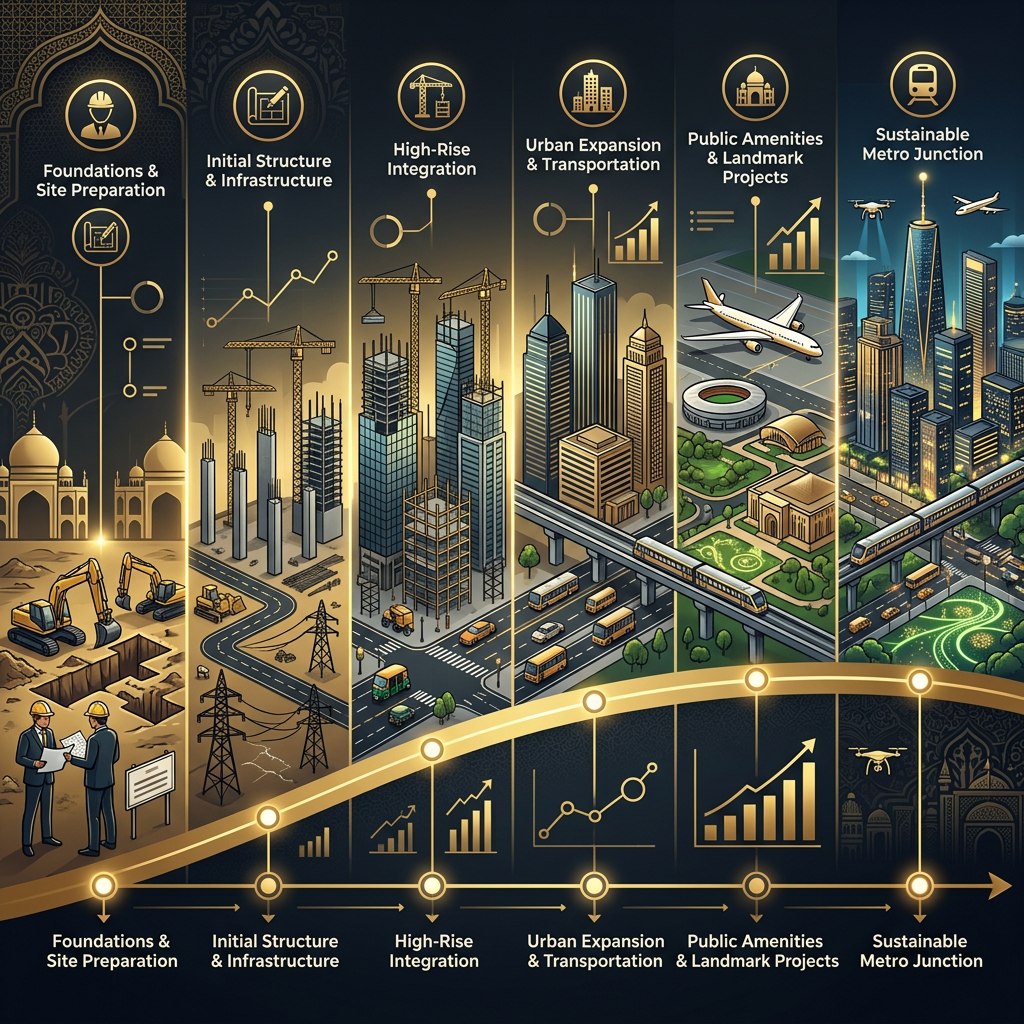
I have been tracking Dholera's progress closely for years. The last two years, 2025 and 2026, have been the most significant since the project was conceived in 2009. After more than a decade of planning, land acquisition, and construction, the infrastructure is finally becoming operational. Here is what actually happened, and what has not happened yet.
The expressway changed everything
The biggest milestone was the Ahmedabad-Dholera Expressway. It opened in March 2026 after years of construction. The 108 km, 8-lane greenfield expressway was built at approximately Rs 4,500 crore. Prime Minister Narendra Modi inaugurated it personally.
Before the expressway, getting from Ahmedabad to Dholera took 2.5-3 hours on congested village roads. Now it takes about 40 minutes. That is closer than many parts of Ahmedabad during rush hour. This single piece of infrastructure has transformed the perception and reality of investing in Dholera.
I remember driving to Dholera before the expressway opened. The roads were bad, the drive was long, and it felt remote. Now, with the expressway, it is a comfortable drive that does not require any planning. You can visit Dholera and return to Ahmedabad the same day without any hassle.
The airport is operational
Dholera International Airport Phase 1 became operational with a 3,200m runway. That is long enough for wide-body aircraft like Boeing 777s. The airport has a passenger terminal and cargo facilities.
A dedicated 9.56 km spur road connects the airport directly to the expressway. This means cargo can move between the airport and Ahmedabad without passing through local roads or village traffic. For industries that need air freight (like semiconductor components), this is a significant logistics advantage.
Infrastructure in the Activation Area
The Activation Area (22.5 sq km) now has complete trunk infrastructure:
Roads: 72 km of internal roads ranging from 18 to 70 meters wide. Each road has an underground utility corridor integrating water, gas, ICT, and other utilities. I have driven on these roads. They are wide, well-maintained, and built to international standards.
Water: A 50 MLD Water Treatment Plant is operational, scalable to 150 MLD. The plant treats and supplies water to the entire Activation Area.
Sewage: A 10 MLD Sewage Treatment Plant is operational, scalable to 30 MLD. All wastewater is treated and reused (Zero Liquid Discharge).
Effluent: A 20 MLD Effluent Treatment Plant is operational, scalable to 60 MLD. This handles industrial effluent from the semiconductor fab and other industries.
Power: Torrent Power has built two advanced substations including a 400/220 kV gas-insulated, SCADA-enabled substation. Current distribution capacity is 500 MVA, scalable to 1500 MVA. A second 400kV substation by GETCO is being developed for dual-source redundancy.
ABCD Building: The Administrative and Business Centre for Dholera is fully operational. It houses the City Integrated Operations Centre (CIOC), which monitors and manages the city's infrastructure in real time, and an Experience Zone for visitors.
Industrial progress
This is where things get interesting for investors.
Tata Semiconductor Fab: Tata Electronics' Rs 91,000 crore semiconductor fabrication plant is under construction. The Union Cabinet approved a 66-hectare Special Economic Zone specifically for this facility. Tata has partnered with Taiwan's PSMC for the technology. First commercial chips are expected by late 2026, with full operations by FY 2030.
I have seen the construction site. There is real activity happening. This is not a project that was announced and then forgotten. Tata is actively building.
ASML Partnership: Tata signed an MoU with ASML, the world's most advanced lithography company, to supply equipment and train engineers for the Dholera fab. ASML is a Dutch company that makes the machines that manufacture semiconductors. They are the only company in the world that makes the most advanced lithography equipment. The fact that they are partnering with Tata for Dholera is a strong signal.
Tokyo Electron: The Japanese semiconductor equipment manufacturer is expanding its presence in Dholera, supporting the growing semiconductor ecosystem.
L&T Vyoma Data Centers: L&T is building massive data center campuses in Dholera, positioning it as India's digital infrastructure hub.
Renew Power: 150 MW solar project as part of India's largest renewable energy park near Dholera. This is operational and generating power.
Adani-Embraer: The aerospace joint venture is setting up manufacturing facilities in Dholera.
Government investment
The government has put real money behind Dholera. In the Gujarat Budget 2026, approximately Rs 610 crore was allocated specifically for Dholera Smart City development. This covers the expressway, airport, internal roads, logistics parks, utilities, and trunk infrastructure.
PM Modi also inaugurated Rs 26,354 crore worth of projects in Gujarat, including major initiatives in Dholera. When the Prime Minister personally inaugurates projects worth thousands of crores, it signals strong political commitment. This is not a project that will be abandoned.
What has not happened yet
I want to be honest about what is still pending. It is easy to get caught up in the excitement and forget that Dholera is still in early stages.
Residential communities: There are no significant residential communities yet. People do not live in Dholera. Workers commute from Ahmedabad and nearby towns.
Schools and hospitals: The government is building a multi-speciality hospital and an integrated school, but neither is operational yet.
Commercial activity: There is no retail or dining ecosystem. No grocery stores, restaurants, or entertainment. The only activity is industrial.
Full airport operations: Phase 1 is operational, but full commercial operations with multiple airlines and regular scheduled flights are still developing.
Population: The target is 2 million residents by 2040-2050. As of 2026, the residential population is negligible.
What this means for investors
The 2025-2026 period has been transformative for Dholera. The shift from "planning" to "operational" is significant because it changes the risk profile of the investment.
Before 2025, investing in Dholera was a bet on government promises. After 2026, it is a bet on operational infrastructure and committed industrial investment. The expressway is built. The airport is functional. The semiconductor fab is under construction. These are facts, not projections.
For investors who bought plots in 2020-2022, the appreciation has been approximately 140% (from Rs 1,000 to Rs 2,400 per sq. yard city-wide average). The expressway and airport corridors have seen even higher appreciation, roughly 2x.
The next phase of growth will come as the semiconductor fab becomes operational (2026-2030) and residential communities start forming. That is when the real demand for housing and commercial space will kick in.
The bottom line
Dholera in 2026 is a fundamentally different investment than Dholera in 2020. The infrastructure is built. The industries are committed. The expressway is open. The risk is lower, and the timeline to meaningful returns is shorter.
That said, the city is still in early stages. There is no residential community, no schools, no hospitals. The full vision of a 2 million population city is still decades away. But the foundation is solid, and the momentum is real.
Want to discuss how the progress affects your investment decisions? Contact our team.