All utilities built before you arrive. Infrastructure that works on day one.
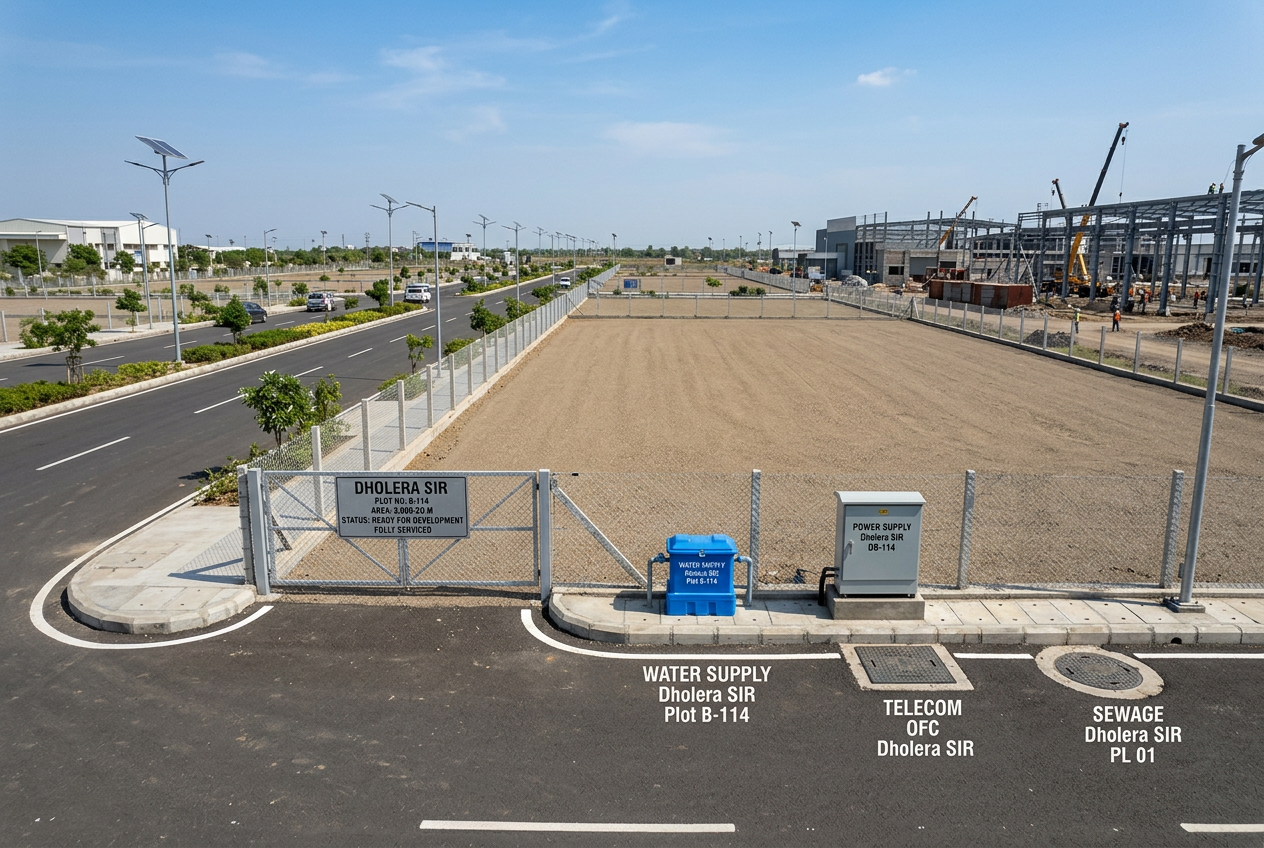
Ready plot — road built, utilities connected, street lights operational
In Indian real estate, buying a plot usually means buying a promise. The developer says roads will come. Water will be connected. Electricity will be laid. Sewage will be handled. But "will come" is doing a lot of heavy lifting in that sentence. Buyers pay upfront and then wait, sometimes for years, for basic infrastructure to arrive. Some projects never deliver at all.
Dholera's plug-and-play model works differently. When a plot is allocated to you, every utility is already built to your plot boundary. The road is paved. The water line is connected. The sewage connection is in place. The electricity line is terminated at your boundary. The telecom fiber is laid. You do not coordinate with five different government departments to get basic services. They are already there, tested, and operational.
Full-width paved roads with stormwater drainage, street lighting, and footpaths. Accessible from day one.
Potable water connection from the Narmada canal system. Dual pipeline for potable and recycled water.
Underground sewage connection leading to the treatment plant. No septic tanks required.
Underground power cable terminated at your boundary. Grid managed by Torrent Power with semiconductor-grade reliability.
Fiber-optic backbone laid to every plot. 5G-ready infrastructure for high-speed connectivity.
Piped gas connection available in designated zones. No cylinder dependency.
The infrastructure is built before plots are offered to buyers. This is the fundamental difference. In a typical Indian development, the developer sells the land first and builds infrastructure later (or in phases, or sometimes never). The buyer bears the risk of delivery timelines. In Dholera, the city authority (DICDL) builds the complete infrastructure network first. Roads, underground utility corridors, water treatment, sewage treatment, power distribution, and telecom backbone are all constructed and tested. Only then are plots allocated.
The underground utility corridors are the key engineering feat. Over 250 km of precast concrete tunnels carry all services beneath the roads. Built by Fuji Silvertech with corrosion-resistant rubber gaskets designed for the saline coastal environment. Maintenance access is through modular chambers, not by digging up roads. This is what "plug-and-play" means at the infrastructure level: a complete, accessible, maintained network that connects directly to your plot.
The plug-and-play model eliminates the two biggest risks in Indian land investment: infrastructure delays and hidden costs.
No hidden costs. In typical Indian real estate, you budget for the plot price, then face additional expenses for road access, water connections, electricity, sewage, and site preparation. These hidden costs add 20% to 40% to the effective price. In Dholera, the advertised price includes everything. The infrastructure is built. The connections are made. What you see is what you pay.
No waiting risk. In many projects, buyers pay upfront and then wait years for infrastructure. Some developments never complete their promised amenities. In Dholera, the infrastructure exists before the plot is allocated. You are not betting on future delivery. You are buying into completed infrastructure.
No road digging. Because all utilities run through dedicated underground corridors, maintenance never requires tearing up roads. The "dig-free" paradigm means your access routes, parking, and logistics are never disrupted by utility work.
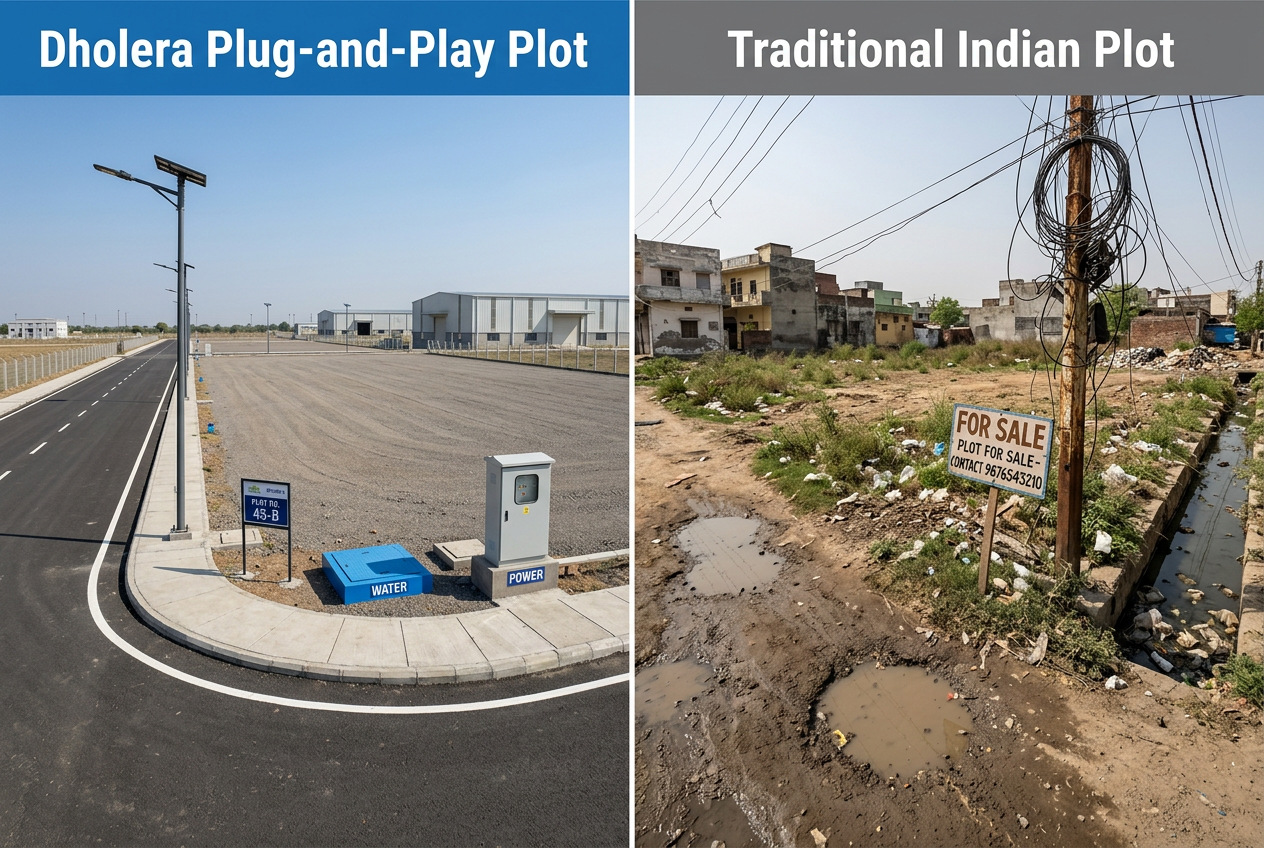
Dholera plug-and-play vs traditional Indian plot
| Factor | Traditional Indian Plots | Dholera Plug-and-Play |
|---|---|---|
| Roads | Built after allocation, often delayed | Built and operational before allocation |
| Water Connection | Buyer applies, waits months | Pre-connected to boundary |
| Electricity | Buyer applies, transformer delays | Underground cable terminated at boundary |
| Sewage | Septic tank or delayed municipal connection | Underground connection to treatment plant |
| Telecom | Buyer coordinates with provider | Fiber backbone pre-laid |
| Maintenance Access | Roads dug up for repairs | Dedicated utility corridors, no digging |
| Hidden Costs | 20-40% above advertised price | All-inclusive pricing |
| Delivery Timeline | Uncertain, buyer bears risk | Infrastructure complete before allocation |
Plug-and-play is not a marketing term in Dholera. It is a description of physical infrastructure that exists on the ground. The roads are built. The pipes are laid. The power is connected. The fiber is in place. When you buy a plot here, you are buying a finished product, not a promise. That is the difference between investing in a planned city with completed infrastructure and buying into a project that hopes to deliver someday.
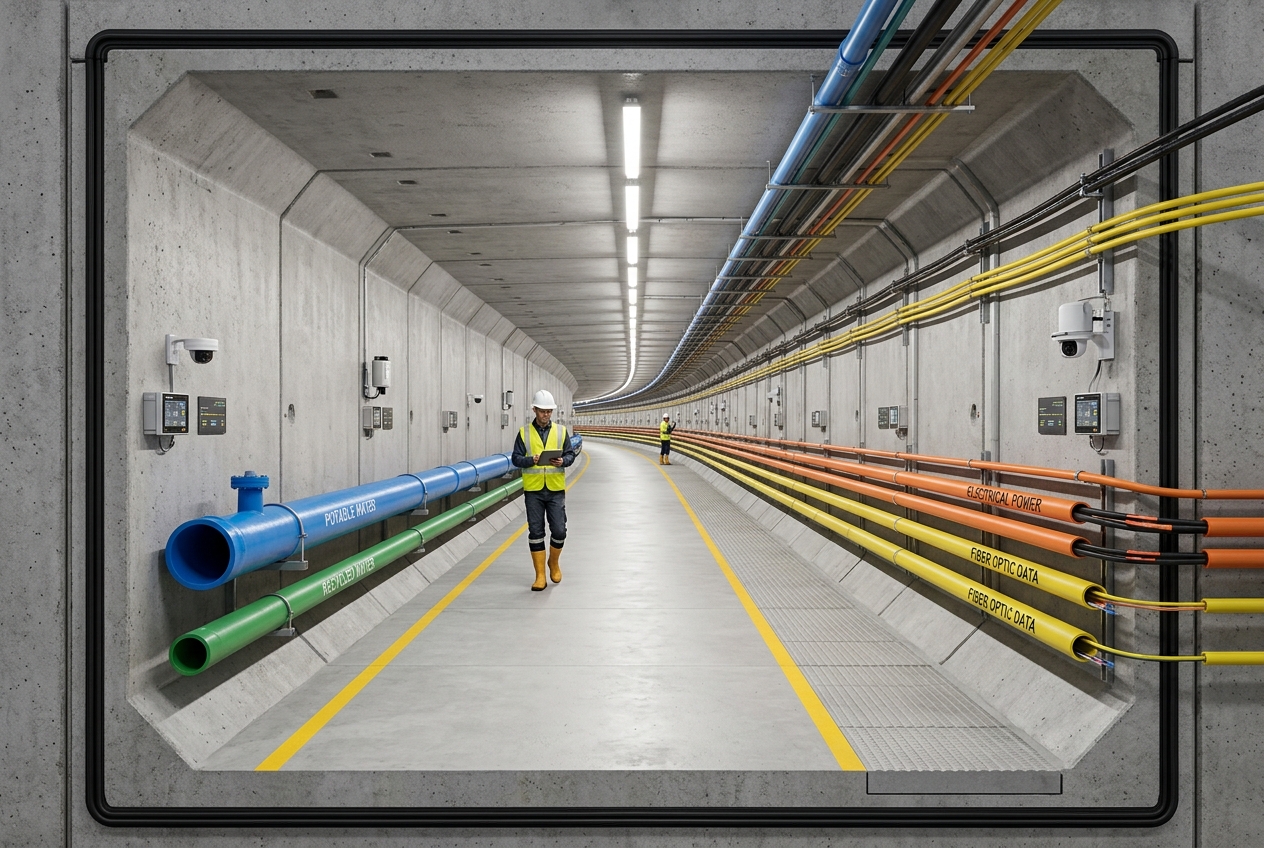
250+ km of precast concrete tunnels — water, sewage, electrical, fiber-optic
The plug-and-play system in Dholera is built on a network of underground utility corridors that run beneath every road. These corridors carry water pipelines, sewage lines, electrical cables, fiber optic cables, and gas pipelines, all in dedicated sections that can be accessed without digging up the road. Each plot has connection points at the boundary, allowing utilities to be connected quickly and efficiently.
When a plot is allocated, the developer simply connects to the nearest junction box. Water is connected by opening a valve. Electricity is connected by plugging into the pre-installed distribution point. Sewage is connected by linking to the underground pipe. Fiber is connected by splicing into the nearest cable. The entire process takes days, not months, and requires no road excavation or disruptive construction work.
The plug-and-play model benefits different types of investors in different ways. For residential buyers, it means you can start building your home immediately after allocation. There is no waiting for roads to be built, no negotiating with utility companies, no dealing with contractors who promise connections that never materialize. The infrastructure is there, ready to use.
For commercial investors, the plug-and-play model means faster time to market. A retail store, office building, or hotel can be operational within months of allocation, not years. The utility connections are guaranteed, the roads are built, and the access is assured. This reduces the financial risk of commercial development significantly.
For industrial investors, the plug-and-play model is even more valuable. Manufacturing facilities require reliable power, water, and sewage connections. In traditional industrial areas, these connections can take months to establish, delaying production and increasing costs. In Dholera, industrial plots come with guaranteed utility connections that are tested and operational before allocation. A factory can be built and commissioned in a fraction of the time required in traditional industrial areas.
The process of acquiring and developing a plug-and-play plot in Dholera is straightforward. First, you select a plot from the available inventory. The plot is already surveyed, demarcated, and connected to the utility network. Second, you complete the purchase and receive allocation documents that specify the exact location, boundaries, and available utilities. Third, you engage a contractor and begin construction. The contractor connects to the pre-installed utilities at the plot boundary and starts building.
There are no surprises in this process. The roads are already built. The utilities are already connected. The access is already guaranteed. The only variable is the building itself, which is entirely under your control. This predictability is rare in Indian real estate, where delays and cost overruns are the norm rather than the exception.
The financial advantages of plug-and-play development are significant. In traditional Indian real estate, hidden costs can add 20 to 40 percent to the advertised price of a plot. These costs include road development charges, utility connection fees, sewage connection charges, and various administrative fees that are not disclosed upfront. In Dholera, all of these costs are included in the plot price. What you see is what you pay.
The savings extend beyond the initial purchase. Because the infrastructure is new and well-maintained, ongoing maintenance costs are lower. The roads do not need repair for decades. The utility connections are designed for minimal maintenance. The underground corridors prevent damage from weather, traffic, or construction work. For investors, this means lower total cost of ownership over the life of the property.
The plug-and-play infrastructure is designed for the future, not just the present. The utility corridors have capacity for additional cables and pipes, allowing upgrades without road excavation. The power distribution system is designed for smart grid integration, enabling solar panel connection and energy storage. The fiber network has capacity for future technologies that have not yet been invented.
This future-proofing means your investment appreciates not just because of general market growth, but because the infrastructure around it keeps improving. When Dholera adds new features, when new technologies become available, when the city grows, your plot benefits from infrastructure that was designed to accommodate change. That is the true value of plug-and-play: a property that keeps pace with progress.
← Back to Vision