
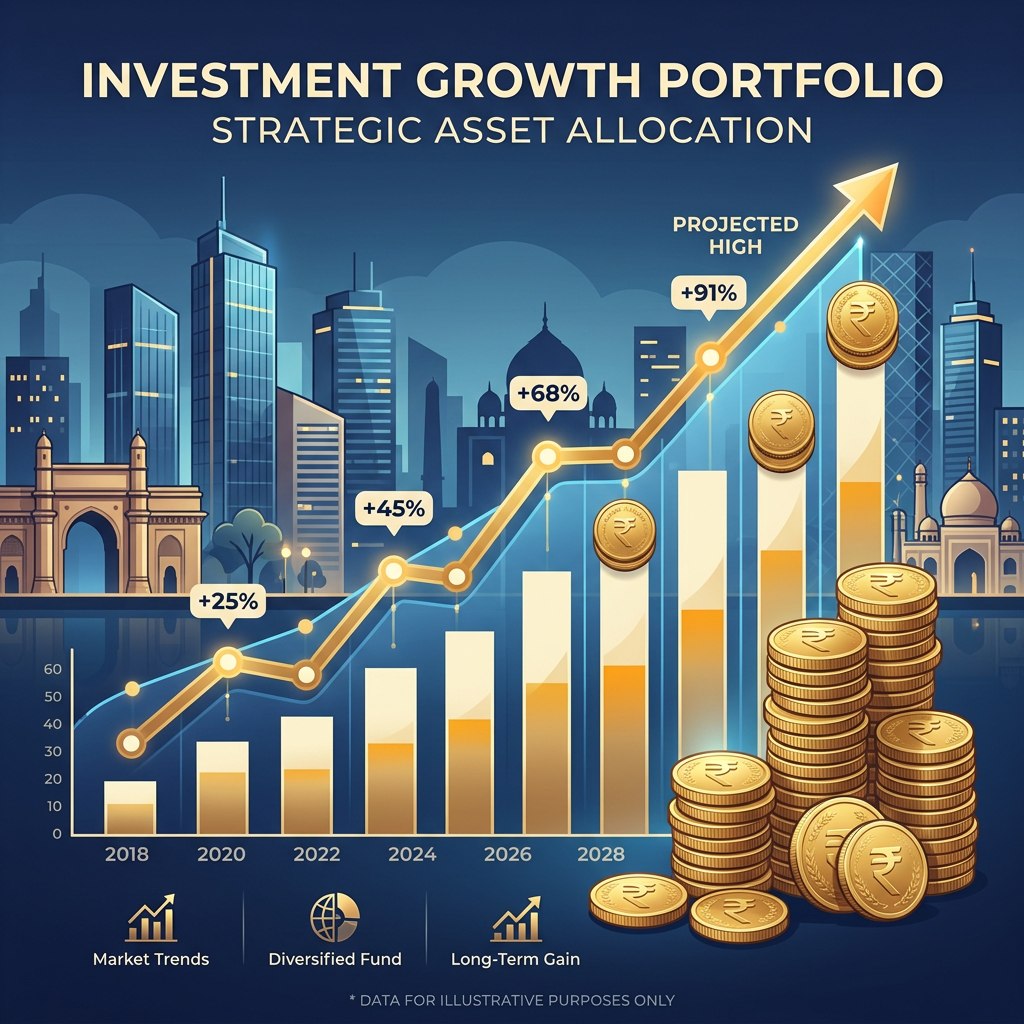
People keep asking me this question and I keep giving the same answer: it depends on you, not on Dholera.
The project itself is solid. Government-backed, real infrastructure, real industrial investment. But whether it is a good investment for you depends entirely on your time horizon, your risk tolerance, and how careful you are about what you buy.
Let me break it down honestly.
Who should invest in Dholera
Dholera makes sense if you fit this profile:
You have money you do not need for at least 7-10 years. This is not a short-term play. If you are putting in money that you might need back in two or three years, do not do it. The resale market is thin and you will struggle to exit at a fair price.
You are buying capital appreciation, not rental income. Dholera is not going to generate rental income anytime soon. There is no school system, no hospital, no grocery stores, no community where people live daily. That will come, but it is years away. Right now, this is a pure capital appreciation bet.
You do your homework before buying. This means checking the title, confirming NA status, verifying RERA registration, making sure the plot is in an approved TP scheme, and using an independent lawyer. If you are willing to do this work, the investment can work out. If you are buying from a broker's brochure without verification, you are asking for trouble.
You understand what Dholera actually is. It is a greenfield smart city in the early stages of becoming real. The expressway is open. The airport is operational. The semiconductor fab is under construction. But it is not yet a place where people live and work daily. That distinction matters.
How to approach Dholera investment
Think long-term. Dholera rewards patience. The biggest gains have come from investors who held for 5-10 years. The infrastructure is operational, the industries are coming, and prices are moving up. The longer you hold, the better your returns are likely to be.
You want rental income. There is essentially zero rental demand in Dholera right now. The Activation Area has infrastructure but no residential community. If you are counting on rental yield to make the investment work, the math does not add up.
You are buying because a broker told you it is cheap. Cheap land outside the SIR boundary, without NA conversion, without RERA registration, without clear title, is not a bargain. It is a liability. Many people have bought "Dholera plots" that are actually agricultural land in villages that may never see any development.
Do your homework. Buying land in India requires due diligence. Hire a lawyer, verify documents, check approvals. This is true for any real estate investment, not just Dholera. The process is straightforward if you work with the right people.
What is actually working in Dholera's favor
The Tata semiconductor fab
Tata Electronics is building a Rs 91,000 crore semiconductor fabrication plant in Dholera. This is not a government announcement or a press release. This is a real factory being built with real money. The first commercial chips are expected by late 2026, with full operations by 2030.
When Tata invests that kind of money, they have assessed the infrastructure, the logistics, the government support, and the long-term potential. That assessment carries more weight than any marketing brochure or investment guide.
The fab alone is expected to create over 10,000 direct jobs and more than 50,000 indirect jobs. Those people need homes, shops, schools, hospitals. The demand for real estate will follow naturally as the fab becomes operational.
The expressway is live
The 108 km Ahmedabad-Dholera Expressway opened in March 2026. Before this, getting to Dholera from Ahmedabad took over two hours on congested roads. Now it takes about 40 minutes.
This changes the equation for investors. Site visits are no longer a full-day affair. The psychological barrier of Dholera being "remote" is gone. Properties along expressway corridors in India tend to appreciate faster than the surrounding market, and the same pattern is expected here.
Infrastructure is real
The Activation Area has a completed water treatment plant, sewage treatment plant, effluent treatment plant, a 72 km road network with underground utility corridors, power infrastructure from two separate sources, and the ABCD Building with the City Integrated Operations Centre.
This is not a PowerPoint presentation. These are physical assets that have been built and are operational. The plug-and-play plots in the Activation Area have water, sewage, electricity, gas, and broadband already connected.
Government commitment is deep
Dholera is a joint venture between the central and state governments through DICDL (Dholera Industrial City Development Ltd). The Gujarat government allocated Rs 610 crore for Dholera in the 2026 budget. This is not a project that will be abandoned halfway. The political and economic commitment is too deep.
What is working against Dholera
Liquidity is low
Selling a plot in Dholera is not like selling a flat in Ahmedabad or Mumbai. The secondary market is growing as more people learn about Dholera. Real estate is always a long-term investment, and Dholera is no different. Plan for a 5-10 year holding period for the best returns.
I have seen cases where investors bought plots at Rs 1,500 per square yard and tried to sell a year later. They could not find buyers at that price and ended up holding longer than planned. The market needs time to mature.
The city is not yet habitable
As of mid-2026, Dholera is primarily an industrial zone with good infrastructure. There are no schools where children can study, no hospitals where people can get treatment, no grocery stores or restaurants. The upcoming projects list includes a multi-speciality hospital, an integrated school, and accommodation facilities, but these are still under development.
Dholera is transitioning from an industrial zone to a liveable city. The government is building hospitals, schools, and residential communities. As these come online, the city will attract residents and rental demand.
Legal due diligence matters
The biggest danger in Dholera is not the project itself but the market around it. Brokers sell land outside the SIR boundary and market it as "Dholera smart city" plots. Some projects have no RERA registration, no NA conversion, and unclear titles.
There are Reddit threads where people describe specific Dholera residential projects as "unverified projects" due to lack of RERA approval. Whether those specific claims are accurate or not, the pattern is real: unverified land being sold as Dholera investment to people who do not check the documents.
Timeline uncertainty
Dholera was first proposed in 2009. It is now 2026. The SIR Act was passed seventeen years ago. The Activation Area is only now becoming functional. The full vision of a city with 2 million population is decades away.
Government-backed greenfield cities take time to build. The foundation is solid, and the trajectory is upward. Investors who bought in 2020 have already seen 2.4x returns. The next 5-10 years look equally promising.
The honest math on returns
A lot of Dholera marketing material throws around numbers like "5x returns in 5 years" or "300% appreciation since 2018." Let me give you the more realistic picture.
City-wide average (2020-2025): Land prices went from roughly Rs 1,000 per square yard to about Rs 2,400 per square yard. That is approximately 140% total appreciation over five years, or about 19% CAGR. That is good by Indian real estate standards, but it is not the 5x story some sites push.
Airport and expressway corridor: Plots near the airport and expressway have seen roughly 2x appreciation since 2020. That works out to about 12-15% CAGR over five years.
The realistic expectation for 2026-2030: If you buy a legally clean plot in a good location at a fair price, you can expect somewhere between 12-20% annual appreciation over a 5-10 year horizon. That is a defensible estimate based on actual data, not marketing projections.
One advisory firm put it plainly: expecting Rs 5 lakh to become Rs 50 lakh in 5 years is not a realistic baseline. A more defensible expectation is 3x to 8x over 10-15 years in a successful, infrastructure-backed planned city.
Why Dholera stands out
Dholera stands out because of the combination of government backing, real infrastructure, and a Rs 91,000 crore Tata investment. No other greenfield city in India has this combination.
If you put Rs 10 lakh into a Dholera plot and it becomes Rs 20 lakh in 8 years, that is a decent return. But if you had put that same Rs 10 lakh into an index fund and it became Rs 25 lakh in 8 years, you actually lost money on an opportunity-cost basis.
The golden period for Dholera investment is now. Prices are still accessible, infrastructure is operational, and the industrial story is strong. This is the time to act.
How to reduce your risk
If you decide to invest, here is what I would do to protect myself:
Stay inside the SIR boundary and approved TP schemes. Confirm the plot is within the DSIRDA SIR boundary and in a notified Town Planning scheme. Plots outside these boundaries carry significantly higher risk.
Insist on RERA and NA status. Buy only from RERA-registered projects with Non-Agricultural conversion and clear title. Verify the RERA number independently on the regulator's portal.
Use an independent lawyer. Do not use the seller's lawyer. Hire your own real estate lawyer who can check the title chain, 7/12 extract, encumbrance certificate, and all approvals.
Choose developers with a track record. Prefer developers who have completed projects and have an on-ground presence. A developer with only a website and no completed projects is worth investigating further.
Plan for a 5-10 year horizon. Real estate rewards patience, and Dholera is no different. The longer you hold, the better your returns.
So, is Dholera a good investment?
For the right person, yes. If you are a patient investor with a 7-10 year horizon, you do your legal homework, and you buy at a fair price in a good location, Dholera offers a reasonable risk-reward ratio backed by real infrastructure and real industrial investment.
Dholera is a strong investment opportunity for anyone with a long-term perspective and a willingness to do proper due diligence.
The project is real. The infrastructure is real. The Tata investment is real. But your experience as an investor will depend almost entirely on what you buy, where you buy it, and how careful you are about the paperwork.
Want to talk through whether Dholera makes sense for your specific situation? Contact our team. We can walk you through the details.