Why Dholera starts clean, and why that matters for every rupee you invest.
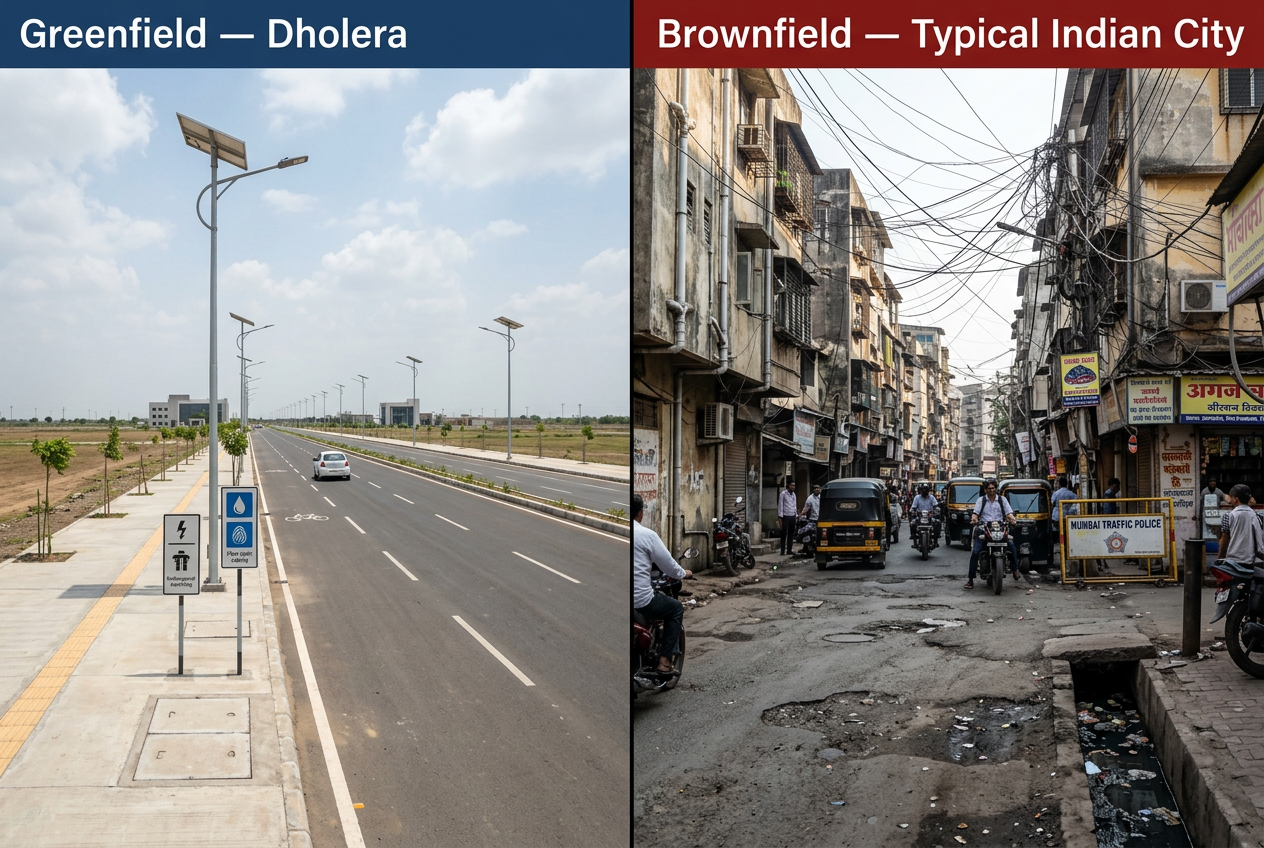
A greenfield site is land that has never been built on. No prior structures, no underground pipes, no buried foundations from someone else's project. The soil is virgin. The air is clean. Every decision about what goes where, from roads to water lines to data cables, starts from scratch with current engineering standards.
This is not a semantic difference. It is a fundamental economic advantage. Brownfield sites (previously developed urban land) carry hidden liabilities. Soil contamination from old factories. Underground utilities that may or may not match existing maps. Structural assessments of aging buildings that need demolition before new construction can begin. Each of these adds cost, time, and risk to development.
Dholera sits on flat, saline terrain in Gujarat's Gulf of Khambhat region. The land is low in agricultural productivity, which sounds like a disadvantage until you realize it means something else: minimal displacement of farming communities, no fertile topsoil being paved over, and landowners who are generally willing to participate in development schemes because the land generates limited income as is. The terrain itself is flat, which means no expensive grading, no hillside stabilization, no complex drainage engineering. The ground is ready for construction with basic preparation.
| Factor | Greenfield (Dholera) | Brownfield (Typical City) |
|---|---|---|
| Contamination | None. Virgin soil. | Possible industrial waste, old fuel tanks, asbestos. |
| Underground Utilities | Designed and installed from scratch. Everything on digital maps. | Legacy pipes, uncharted wiring, conflicting utility records. |
| Design Freedom | Full. No existing structures to work around. | Constrained by existing roads, buildings, rights-of-way. |
| Retrofitting Costs | Zero. No old systems to upgrade. | High. Existing infrastructure often decades old. |
| Timeline | Faster. Build to current specifications immediately. | Slower. Demolish, remediate, then build. |
| Smart Integration | Baked in. IoT sensors, fiber, smart meters from day one. | Retrofitted. Disruptive. Expensive. |
Dholera's developers have made a deliberate choice to market against the brownfield model. Most Indian cities are expanding by retrofitting existing infrastructure, bolting smart systems onto old pipes, running fiber alongside century-old sewage lines. The results are predictable: cost overruns, system incompatibilities, and infrastructure that never quite works as designed.
Dholera takes the opposite approach. Every utility corridor is engineered for today's technology and tomorrow's upgrades. Water pipelines have sensor-ready junctions. Road medians include fiber ducts. Power distribution uses smart grid architecture. None of this required tearing up existing roads or negotiating with established neighborhoods. The city was planned on paper, approved by government, and is now being built exactly as designed. That is the greenfield advantage in practice: infrastructure that works because it was designed to work together, not adapted to coexist.
For real estate investors, the greenfield distinction translates directly into financial advantages. When you invest in a brownfield city, you are paying for infrastructure that may be decades old, systems that will need retrofitting, and a layout that was designed for a different era. When you invest in Dholera, you are buying into infrastructure that is being built to current specifications, with provisions for future upgrades already baked into the design.
Consider the cost implications. In a typical Indian city, upgrading water supply infrastructure costs between Rs 50 and 100 per square meter of road surface torn up and restored. Running new fiber optic cables through established neighborhoods costs 3 to 5 times more than installing them in new developments. Smart metering systems designed for modern pipes cannot be retrofitted onto aging cast iron networks without complete replacement. These hidden costs eat into returns and delay project timelines.
In Dholera, none of these costs exist. The water pipes are new and sensor-ready. The fiber is already in place. The smart meters are being installed as part of the initial build, not as an expensive afterthought. For an investor, this means lower maintenance costs, fewer surprises, and infrastructure that will not need expensive upgrades for decades.
The environmental case for greenfield development is equally compelling. Brownfield remediation, the process of cleaning up contaminated land, is expensive, time-consuming, and often incomplete. Industrial sites may contain heavy metals, petroleum products, or chemical residues that require specialized treatment. In some cases, contamination is so severe that the land can never be fully restored to safe use.
Dholera's greenfield status means none of these environmental liabilities exist. The soil is clean. The groundwater is unaffected by industrial contamination. The development can proceed without the environmental risks associated with building on previously industrialized land. This is not just good for the planet; it is good for property values. Buyers and tenants increasingly prefer locations with clean environmental histories, and Dholera's greenfield status is a permanent marketing advantage.
The true power of greenfield development reveals itself in smart city integration. In brownfield cities, adding IoT (Internet of Things) sensors requires retrofitting existing infrastructure, which is disruptive and expensive. Traffic sensors need to be drilled into existing roads. Air quality monitors need to be mounted on existing buildings. Water quality sensors need to be installed in existing pipes. Each installation requires coordination with existing utilities, road closures, and often, permission from multiple government agencies.
In Dholera, smart infrastructure is part of the original design. IoT sensor nodes are built into road medians during construction. Air quality monitors are integrated into street light poles. Water quality sensors are installed at every junction box during pipe laying. The result is a comprehensive sensor network that provides real-time data on traffic, air quality, water quality, energy consumption, and waste management, all without the disruption and expense of retrofitting.
This integrated approach extends to every aspect of city operations. The command center receives data from thousands of sensors across the city, enabling real-time responses to everything from traffic congestion to water leaks to air quality alerts. None of this would be possible in a brownfield city without massive investment in retrofitting, and even then, the results would be patchy and unreliable.
India has announced dozens of smart city projects, but most are brownfield developments attempting to upgrade existing cities. Dholera stands apart as one of the few truly greenfield smart cities in the country. Here is how it compares:
| Smart City | Type | Key Challenge |
|---|---|---|
| Dholera SIR | Greenfield | Building from scratch (advantage) |
| Amaravati | Greenfield (partial) | Political uncertainty, land disputes |
| GIFT City | Greenfield | Financial hub only, not full city |
| Bhubaneswar | Brownfield | Retrofitting existing infrastructure |
| Pune | Brownfield | Legacy systems, high retrofit costs |
| Jaipur | Brownfield | Heritage constraints, narrow roads |
While brownfield smart cities face the challenge of upgrading decades-old infrastructure, Dholera builds everything new. The result is a city where all systems work together from day one, where smart features are native rather than bolted on, and where the infrastructure is designed for the next 50 years, not adapted from the last 50.
Greenfield development is not just about avoiding problems; it is about creating opportunities. When you build from scratch, you can design for the future in ways that are impossible in existing cities. Dholera's wide road corridors, for example, can accommodate future metro lines without demolition. The utility corridors are designed for easy access and upgrades. The building codes are modern and flexible, allowing for innovative construction techniques that would be impossible in heritage areas.
For investors, this means a property that appreciates not just because of general market growth, but because the infrastructure around it keeps improving without disruption. When Dholera adds new features, when new industries move in, when the population grows, the infrastructure will expand smoothly because it was designed to scale. That is the greenfield advantage: a city that grows without breaking.
← Back to Vision