
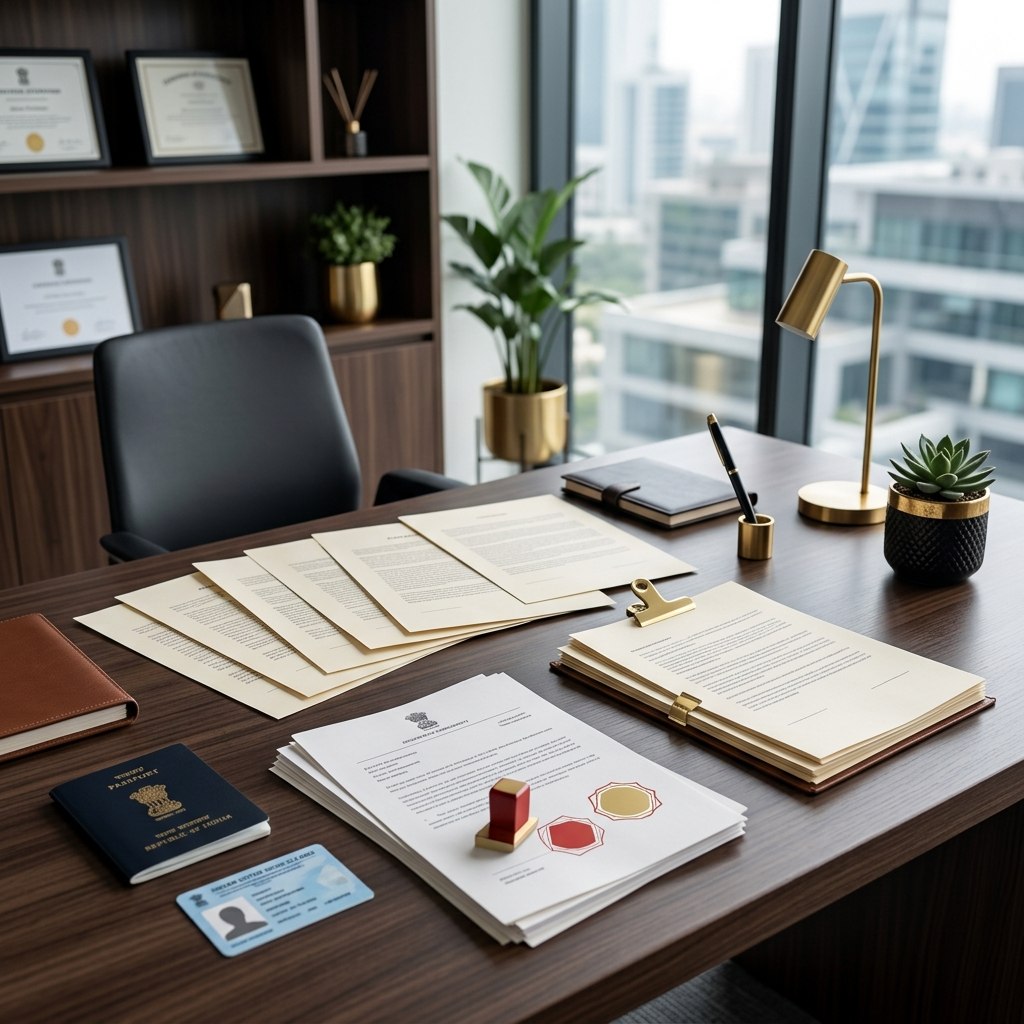
I have seen people lose money because they did not check the documents properly. One person I know bought a plot based on a photocopy of the title deed. Turned out the original was mortgaged to a bank. He is still fighting in court.
Do not be that person. Here is the complete list of documents you need to collect, verify, and keep when buying a plot in Dholera.
Documents to collect from the seller
Title deed
This is the most important document. The title deed proves that the person selling you the plot actually owns it. Ask for the original, not a photocopy. Check the entire chain of ownership going back at least 30 years. If the plot has changed hands multiple times, you need to see every sale deed in the chain.
What to look for: the names on the deed should match the person selling to you. The survey number and area should match the plot you are buying. There should be no mentions of disputes, court orders, or encumbrances. If anything looks off, ask your lawyer to investigate.
NA certificate
NA stands for Non-Agricultural. In Gujarat, any land that is classified as agricultural cannot be used for residential or commercial purposes without a conversion certificate from the Collector's office. The NA certificate confirms that the land has been converted from agricultural to non-agricultural use.
Why this matters: if you buy agricultural land and try to build on it, you can face legal action. The government can demolish the structure and you lose your investment. Always check the NA certificate before buying.
TP scheme approval
If the plot is in a Town Planning scheme, you need the approved layout plan. This plan shows the plot's location within the scheme, its boundaries, the road network, and the zoning (residential, commercial, industrial). It also shows the infrastructure commitments: water supply, sewage, power, and drainage.
The TP scheme approval is what gives you confidence that the infrastructure will actually be built. Without it, the developer's promises are just words.
RERA registration
If you are buying from a developer (not directly from a landowner), the project should be registered with GujRERA. Ask for the RERA registration number and verify it on the portal (gujrera.gujarat.gov.in). Check that the project details match what the developer has told you: project name, location, timeline, and status.
If the developer says the project is RERA registered but cannot give you the registration number, ask for clarification. If the RERA number belongs to a different project, verify which project it actually belongs to. Always do your own verification.
Encumbrance Certificate (EC)
The EC is obtained from the sub-registrar's office. It shows whether the property has any loans, mortgages, or legal claims against it. Ask for an EC covering at least the last 15 years. If the property has been mortgaged at any point in the last 15 years, it will show up on the EC.
A clean EC means no bank has a claim on the property. This is important because if the seller has an unpaid loan secured against the property, the bank can seize it even after you buy it.
7/12 extract
This is a land record document from the revenue department. It shows the current owner, survey number, area, and land classification. The 7/12 extract is how you verify that the land records match what the seller is telling you.
In Gujarat, you can check 7/12 extracts online through the e-Dhara portal. If the online records do not match the documents the seller has given you, investigate further.
Survey report
A recent survey report from a licensed surveyor confirming the plot boundaries, area, and access to roads. This is how you verify that the plot you are buying is actually the size the seller says it is, and that it has proper road access.
Do not skip this step. I have seen cases where the plot area on paper was different from the actual area on the ground. A survey costs a few thousand rupees and can save you from a big mistake.
Development permission
If buying from a developer, check whether they have received development permission for the layout from the relevant authority. This permission confirms that the layout has been approved and the developer can legally sell plots.
No Objection Certificate (NOC)
From the local authority or gram panchayat, confirming no objection to the sale or development of the land. This is especially important for land that was recently converted from agricultural to non-agricultural use.
Property tax receipts
For the last 5 years, confirming no pending taxes against the property. If there are unpaid property taxes, they become your responsibility after you buy the plot.
Documents to prepare yourself
Identity proof: Aadhaar card, PAN card, passport, or voter ID. You need at least two forms of identification. PAN card is mandatory for property registration.
Address proof: Aadhaar card, passport, utility bill, or bank statement showing your current address.
Income proof: If taking a home loan, you need salary slips, bank statements, and IT returns for the last 3 years. Banks want to see that you can repay the loan.
Passport-sized photographs: Usually 4-6 photographs are needed for the registration process. Carry extras just in case.
For NRIs: additional documents
If you are an NRI buying property in Dholera, you need a few extra documents:
| Document | Purpose |
|---|---|
| Passport copy | Identity and NRI status verification |
| PIO/OCI card (if applicable) | Proof of overseas Indian status |
| NRE/NRO/FCNR account statements | Proof of payment channel |
| Inward remittance receipts | Proof of funds brought to India |
| Power of Attorney (if applicable) | Authorization for someone to act on your behalf |
| Tax returns (India and country of residence) | Tax compliance verification |
One thing I want to emphasize about NRIs and Power of Attorney: make it a specific POA, not a general one. A specific POA authorizes the person to do one particular transaction (buying a specific plot). A general POA gives them power to do anything with your property. We have seen general POAs misused. Be specific.
Documents to keep after registration
After the registration is done, do not just shove the papers in a drawer and forget about them. Keep them organized because you will need them later.
Sale deed (registered): This is your primary proof of ownership. Keep the original in a safe place, ideally a bank locker. Also keep a scanned copy on your phone or cloud storage.
Registration receipt: The receipt from the sub-registrar's office confirming the registration was completed. Keep this with the sale deed.
Stamp duty receipt: Proof that stamp duty was paid. You need this for tax purposes if you sell the property later.
Encumbrance Certificate: The EC obtained before the purchase. Keep it for your records as proof that the property was clean at the time of purchase.
Mutation records: After registration, get the land record updated in your name. This is called mutation. Keep the mutation order as proof that the revenue records reflect your ownership.
Property tax receipts: Keep receipts for all property tax payments you make after purchase. These are needed for tax calculations when you sell.
All correspondence: Keep copies of all letters, emails, and agreements with the seller or developer. If there is ever a dispute, these records are your evidence.
Common document problems we have seen
Title deed does not match seller's name: This happens more often than you would think. Sometimes the plot is in the name of a family member, and the seller is selling on their behalf. This is legal only with a proper Power of Attorney or a family settlement deed.
NA certificate missing or expired: Some plots were converted to NA years ago, and the certificate was never obtained. Or the NA certificate has conditions that have not been met. Check carefully.
EC shows old mortgage: The seller may have taken a loan against the property years ago and paid it off, but the bank did not update the records. You need a release deed from the bank to clear this.
Survey area does not match: The area on the title deed is different from the area on the ground. This usually means there was a survey error or the boundaries have shifted. Get a fresh survey done.
RERA registration belongs to a different project: Some developers use RERA numbers from other projects. Always verify that the RERA number matches the specific project you are buying.
The bottom line
Document collection and verification is tedious. It takes time and costs money (lawyer fees, survey fees, EC fees). But it is the most important part of the entire transaction. Skipping document verification is the fastest way to lose your investment.
Keep all documents organized in a physical file and also scan them for digital backup. You will need them for future reference, tax filing, and when you eventually sell the property.
Need help with document verification? Contact our team. We can guide you through the entire process and connect you with trusted real estate lawyers who specialize in Dholera transactions.