How Dholera makes every drop of water count in one of India's driest regions.
Dholera sits in a region where natural water availability is only about 260 cubic meters per capita. For context, India's national average is roughly 1,500 cubic meters, and the water scarcity threshold is defined as anything below 1,000. The rivers near Dholera (the Sabarmati and its tributaries) are ephemeral, meaning they flow only during and shortly after monsoon season. For most of the year, they are dry or nearly dry. Any city built here has to solve water supply as a primary design challenge, not an afterthought.
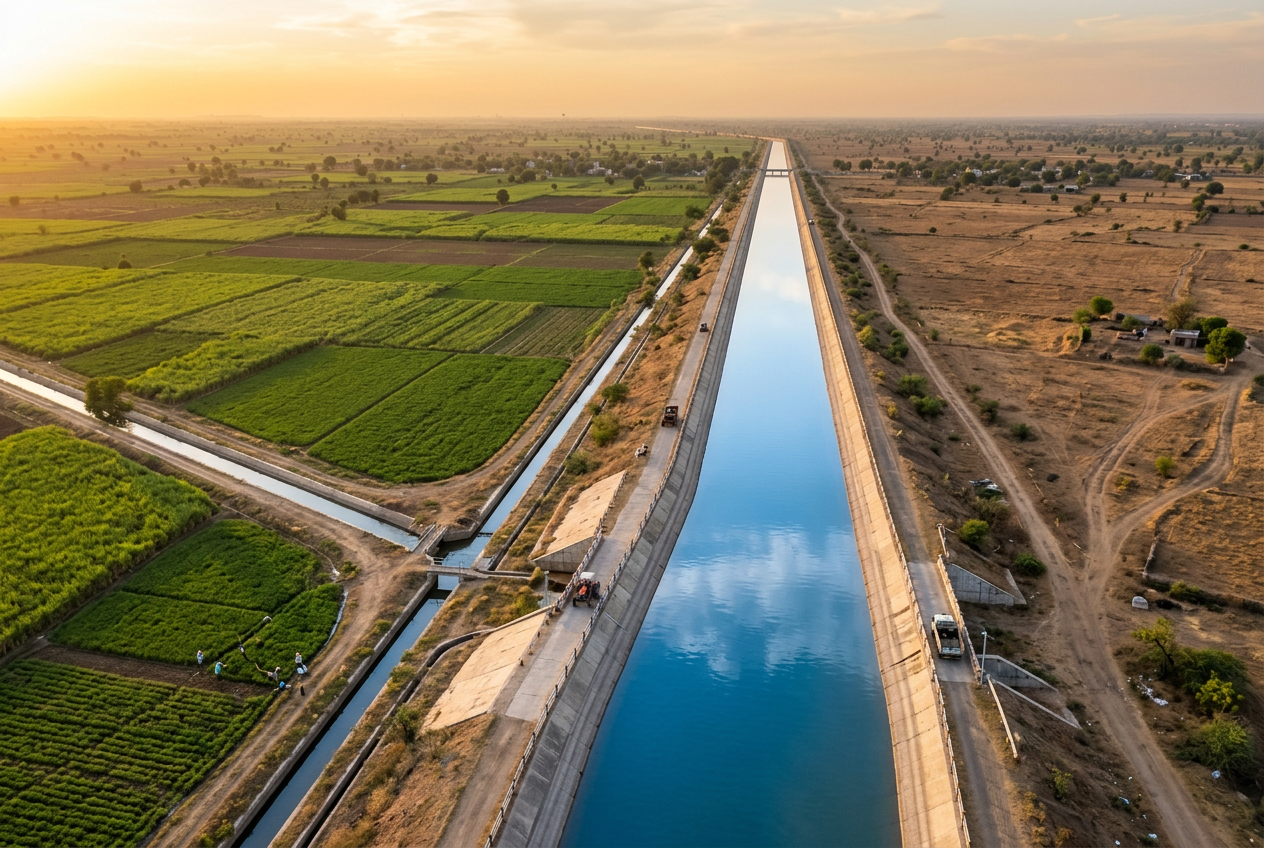
Narmada Canal — year-round water supply to Dholera SIR
Dholera's main water supply comes from the Narmada Canal, which carries water from the Narmada River across Gujarat. This is a reliable, year-round source that does not depend on local rainfall. The canal feeds a dedicated water treatment plant with an initial capacity of 50 million liters per day (MLD), expandable to 150 MLD as the city grows. The treated water is piped directly to residential, commercial, and industrial zones through a dedicated potable water network.
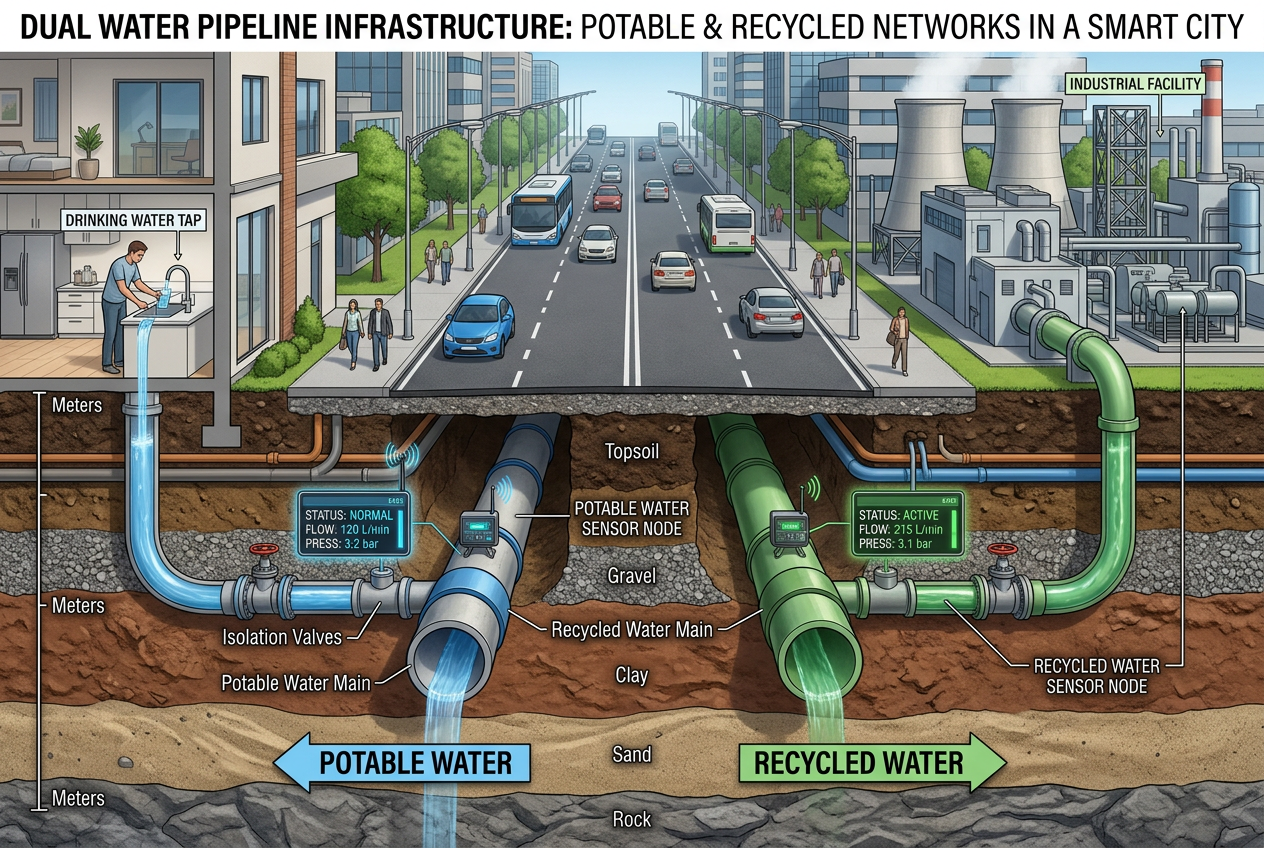
Dual Pipeline System — separate potable and recycled water networks
Dholera operates two entirely separate water networks. The first carries potable (drinking-quality) water from the Narmada treatment plant to homes, offices, and food processing facilities. The second carries recycled water from sewage treatment plants to industrial zones, landscaping, and non-potable uses. This dual system is installed during initial construction, before any residents move in. It is not a retrofit or an upgrade. It is the baseline design.
The recycled water network runs 81 kilometers, connecting sewage treatment plants to industrial end-users. This means factories and manufacturing facilities use treated recycled water for cooling, washing, and process needs, while drinking water is reserved for human consumption. The result is significantly lower demand on the Narmada Canal supply.
Zero Liquid Discharge (ZLD) means that no untreated industrial wastewater leaves the city boundary. All industrial effluent is collected, treated, and either recycled for reuse or converted to solid waste that can be disposed of safely. Dholera's ZLD system includes a Sewage Treatment Plant (STP) with initial capacity of 10 MLD (scalable to 30 MLD) and a Common Effluent Treatment Plant (CETP) with initial capacity of 20 MLD (scalable to 60 MLD). These facilities process wastewater from residential and industrial sources respectively, bringing both to a standard where they can be reused.
| Factor | Dholera | Traditional Indian City |
|---|---|---|
| Water Supply | Narmada Canal (year-round, dedicated) | Mix of groundwater, local rivers, seasonal supply |
| Pipeline Network | Dual system (potable + recycled) | Single network, mixed use |
| Water Loss | Target below 5% | 30% to 50% typical |
| Industrial Water | Recycled, treated, ZLD compliant | Fresh water, no recycling mandate |
| Wastewater | All treated and reused on-site | Partial treatment, some discharged to rivers |
A city that does not waste water is a city that does not run out of it. For residents, this means reliable supply even during drought years. For industrial operators, it means no dependency on water trucking or expensive private tankers. For the environment, it means no untreated wastewater entering the Gulf of Khambhat. The ZLD system is not just an environmental feature. It is a practical necessity that makes the city viable for long-term habitation and industrial operation.
Zero Liquid Discharge is not just an environmental choice; it is an economic one. Water scarcity is a growing problem across India, and industries that depend on large volumes of water face increasing risks. Droughts, water restrictions, and competing demands from agriculture and domestic use can disrupt industrial operations. ZLD eliminates this risk by ensuring that every drop of water used in the city is treated and reused.
For investors, ZLD means lower water costs over the long term. While the initial infrastructure investment is higher than conventional systems, the operational savings are significant. Industries do not need to purchase water from external sources. They do not need to treat wastewater separately. The city's ZLD system handles everything, providing a complete water management solution at a fraction of the cost of individual industrial treatment plants.
ZLD also opens up opportunities for water-intensive industries that would be impossible in water-scarce regions. Industries like semiconductor manufacturing, pharmaceutical production, and food processing require large volumes of clean water. In most Indian cities, these industries face water restrictions and competing demands. In Dholera, the ZLD system ensures that water is always available, making these industries viable and profitable.
The environmental benefits of ZLD extend beyond water conservation. By treating and reusing all wastewater, the system prevents pollution of the Gulf of Khambhat. This protects marine ecosystems, supports fisheries, and maintains the coastal environment that makes Dholera's location attractive. The environmental protection also supports tourism and recreational activities, creating additional economic value from the ZLD investment.
ZLD also reduces the carbon footprint of water management. Pumping and treating water from distant sources consumes significant energy. By recycling water locally, Dholera reduces transportation costs and energy consumption. The treated water is also at ambient temperature, reducing the energy needed for industrial processes that require temperature-controlled water. These efficiency gains add up to significant cost savings and environmental benefits over the life of the city.
← Back to Vision