How one building monitors every pipe, wire, and streetlight in Dholera.
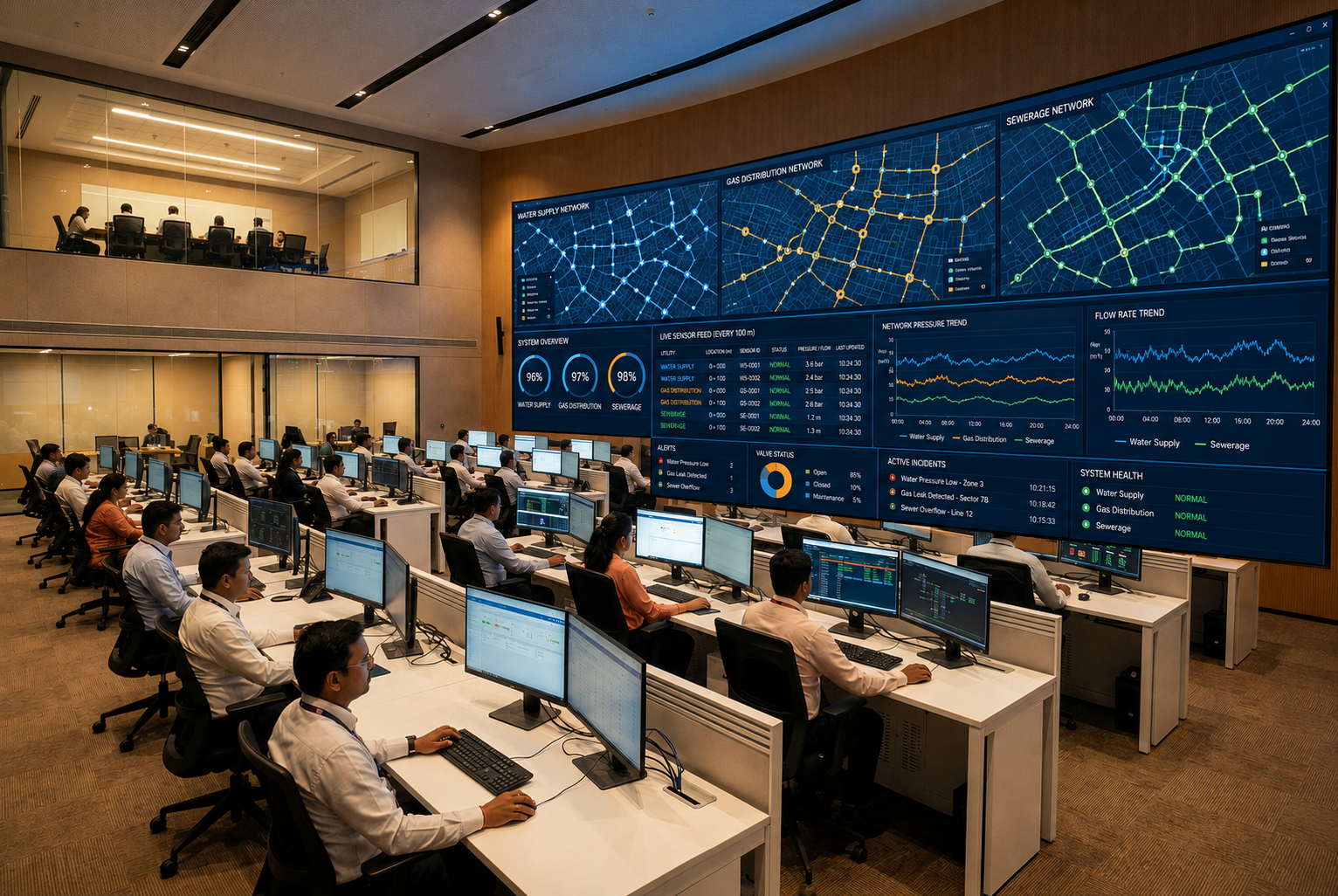
Integrated Command and Control Center — real-time city monitoring
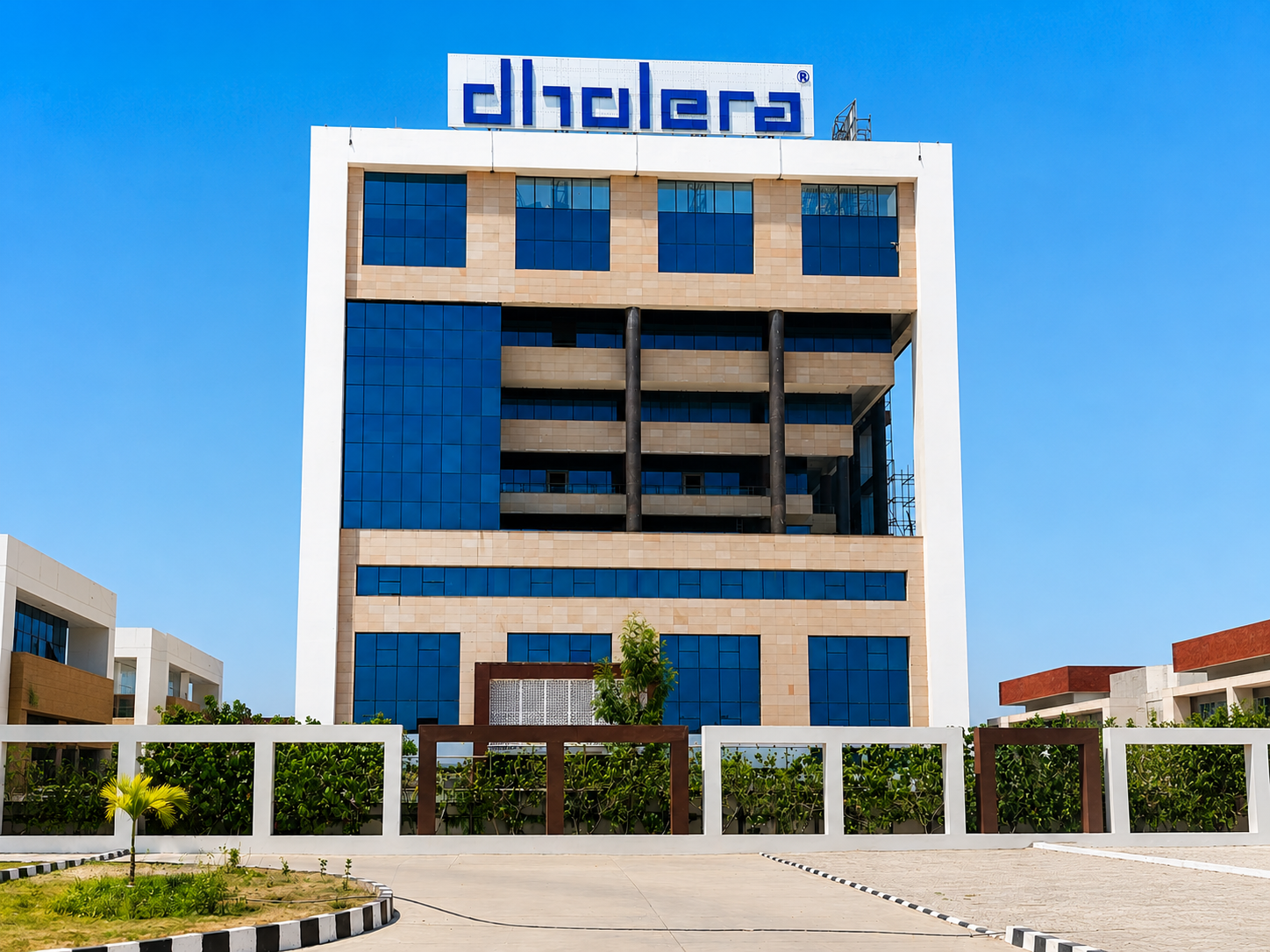
ABCD Building — Administrative and Business Centre for Dholera
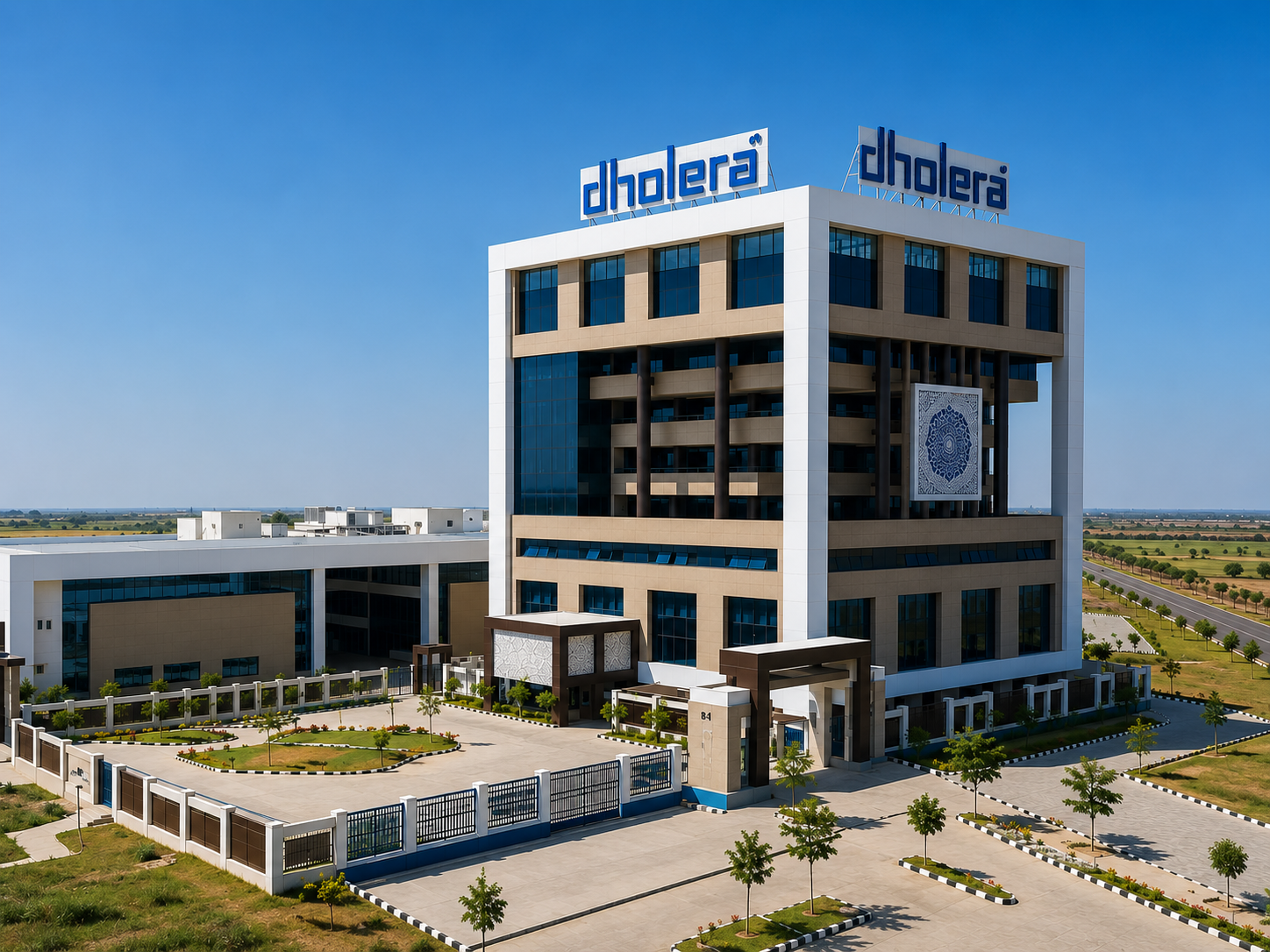
ABCD Building — Phase 1 construction progress
The ABCD Building is Dholera's central nervous system. The name stands for Administrative and Business Centre for Dholera. It is a single structure that houses the city's government offices and commercial coordination spaces. But its real significance is what happens inside the command floor: a full-scale Integrated Command and Control Center (ICCC) that monitors every utility in the city in real time.
Traditional Indian cities are managed reactively. A pipe bursts, someone reports it, a crew is dispatched, and repairs happen hours or days later. Traffic signals run on fixed timers. Power outages are discovered when customers call. Waste collection follows rigid routes regardless of actual bin fill levels. The ABCD Building inverts this model entirely.
Dholera uses SCADA (Supervisory Control and Data Acquisition) systems across its water supply, sewage, solid waste, and energy networks. Every pipeline has pressure sensors. Every pump station reports flow rates. Every waste bin has fill-level indicators. All of this data streams into the command center, where operators see the city's vital signs on a unified dashboard.
The system can detect anomalies automatically. A pressure drop in a water main triggers an alert before a pipe actually bursts. A sewage pump drawing abnormal current gets flagged for maintenance before it fails. Smart meters in residential and commercial zones report consumption patterns, enabling demand forecasting and load balancing. Automated leak detection reduces water loss, which in most Indian cities runs above 30% of total supply.
The ICT backbone is built through a partnership with Cisco, Wipro, and IBM. Cisco provides the networking infrastructure (the physical data paths). Wipro handles system integration and the SCADA platform. IBM contributes analytics and the data processing layer. This is not a single-vendor lock-in. The technology stack is designed for interoperability, meaning components can be upgraded or replaced as better solutions become available.
Every connection point in Dholera, water, electricity, gas, data, has a smart meter that reports usage in near-real-time. For residents, this means accurate billing and the ability to monitor their own consumption. For city operators, it means granular data on demand patterns across the entire city. For investors, it means a utility system that actually knows how much it is producing, where it is going, and where it is being lost. That level of visibility is rare in Indian urban infrastructure.
The Integrated Command and Control Center is not a marketing concept. It is an operational facility where trained staff monitor live data feeds 24 hours a day. The difference between Dholera and a typical smart city project is the difference between installing a few sensors and running a citywide monitoring system from day one. Because Dholera was built greenfield, the SCADA infrastructure was installed during construction, not retrofitted later. Every sensor, every data path, every integration point was designed to work together. That is what makes it a functioning command center, not just a room with screens.
The Integrated Command and Control Center operates on a simple principle: collect data, analyze it, and act on it before problems become crises. The command floor displays a digital twin of Dholera, a virtual replica of the entire city that updates in real time. Operators can see every water pipeline, every power line, every traffic signal, and every waste collection point on a single screen. When something goes wrong, the system highlights the affected area and suggests response options.
For example, if a water main develops a leak, the SCADA system detects the pressure drop within seconds. The command center receives an alert, identifies the exact location on the digital map, and automatically dispatches a repair crew. The system can also isolate the affected section to minimize water loss while repairs are underway. In a traditional city, this process might take hours or days. In Dholera, it takes minutes.
The ICCC is not just for routine monitoring. It serves as the central hub for emergency response across the entire city. In the event of a fire, flood, or medical emergency, the command center coordinates all first responders, including fire services, police, and ambulance teams. The system provides real-time traffic data to help emergency vehicles find the fastest route, and it can automatically adjust traffic signals to clear a path.
The command center also maintains a comprehensive emergency response plan that covers every type of incident, from chemical spills to power outages to natural disasters. When an emergency occurs, operators follow pre-established protocols that assign specific tasks to specific teams, ensuring that response is swift and coordinated. This level of preparedness is impossible in cities where emergency management is fragmented across multiple agencies with poor communication.
Dholera's sensor network includes comprehensive environmental monitoring. Air quality sensors are installed at strategic locations throughout the city, measuring particulate matter, nitrogen dioxide, sulfur dioxide, and other pollutants in real time. If air quality deteriorates in a specific zone, the command center can identify the source, whether it is industrial emissions, construction dust, or traffic congestion, and take appropriate action.
Water quality is monitored continuously at treatment plants, storage tanks, and distribution points. The system can detect contamination instantly and automatically isolate affected sections of the water network. This is particularly important for industrial areas where chemical spills could contaminate the water supply. The environmental monitoring system also tracks noise levels, ensuring that industrial operations do not exceed permissible limits in residential areas.
Traffic management in Dholera goes beyond simple signal timing. The system uses a combination of sensors, cameras, and GPS data to monitor traffic flow across the entire city in real time. When congestion builds up at an intersection, the system automatically adjusts signal timing to improve flow. When an accident occurs, the system detects the disruption and reroutes traffic around the affected area.
The traffic management system also integrates with public transportation, providing real-time arrival information for buses and future metro services. Commuters can access this information through mobile apps, helping them plan their journeys more efficiently. For logistics companies, the system provides route optimization that takes into account current traffic conditions, road closures, and delivery schedules.
The ICCC is not just for city operators. It also provides services to citizens. Residents can report problems, such as potholes, broken streetlights, or water leaks, through a mobile app or website. The command center receives these reports, categorizes them, and dispatches the appropriate team. Citizens can track the status of their reports in real time, from submission to resolution.
This transparency extends to all city services. The command center publishes regular reports on water quality, air quality, traffic conditions, and waste collection efficiency. Residents can access this information through public dashboards, ensuring that city operations are visible and accountable. This level of transparency is rare in Indian cities, where government operations are often opaque and unaccountable.
The command center does not just collect data; it analyzes it. Using advanced analytics and artificial intelligence, the system identifies patterns and trends that human operators might miss. For example, AI algorithms can predict equipment failures before they occur, allowing preventive maintenance that avoids costly breakdowns. Machine learning models can optimize energy distribution, reducing waste and lowering costs for residents and businesses.
The analytics capabilities also support long-term planning. By analyzing traffic patterns, energy consumption, and water usage over time, city planners can make informed decisions about infrastructure investments. If a particular area is experiencing rapid growth, the system can identify the need for additional water capacity, power distribution, or road expansion before problems develop. This proactive approach to city management is only possible because Dholera collects comprehensive data from day one.
← Back to Vision