
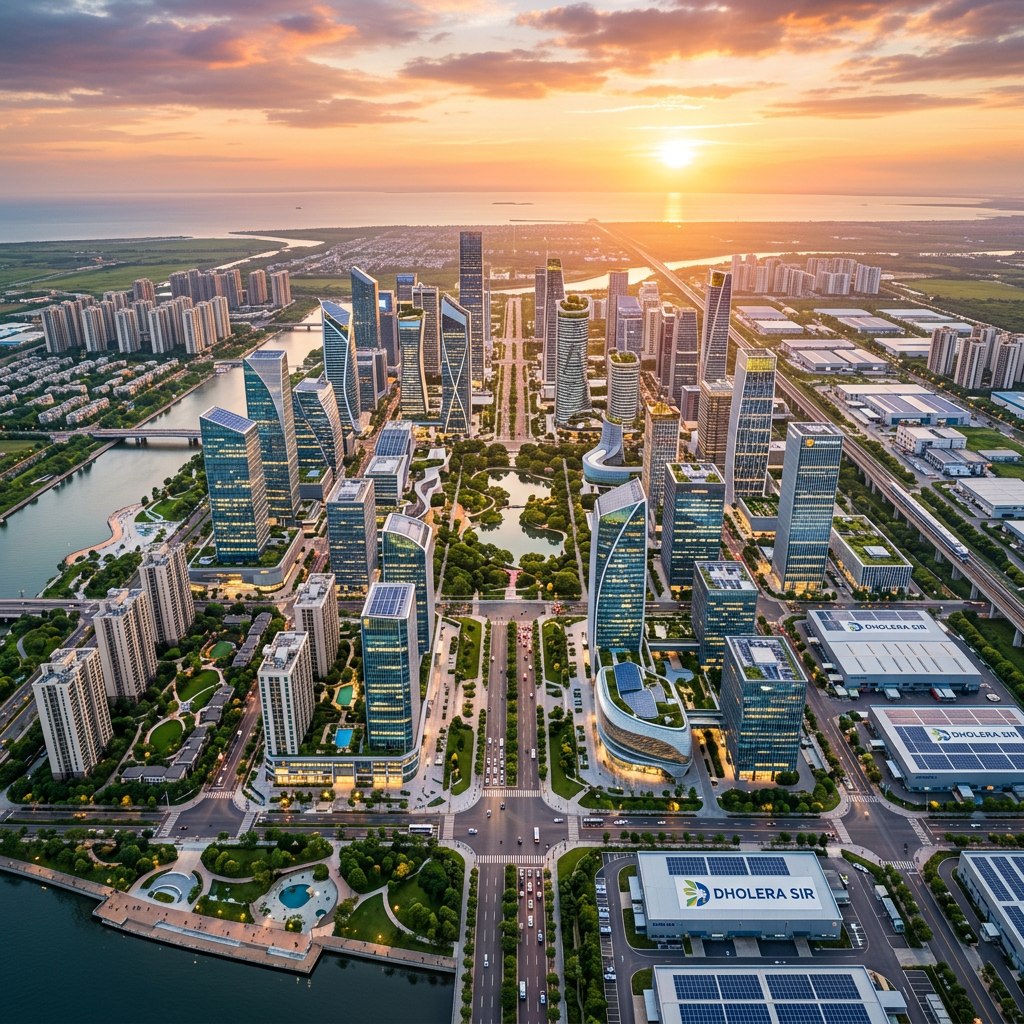
I keep getting asked the same question: is Dholera worth investing in? My honest answer is it depends on what you are expecting. If you want quick returns in two years, probably not. If you are willing to wait eight to fifteen years and do your homework before buying, the numbers look reasonable.
This guide is not a sales pitch. It is a breakdown of what Dholera actually is, what plots cost right now, what returns people have seen, and what you should check before putting money down.
What is Dholera SIR?
Dholera Special Investment Region is a greenfield smart city being built from scratch in Gujarat, about 109 km south of Ahmedabad. The government designated 920 square kilometers for this project under the SIR Act of 2009. The idea was to create India's first planned industrial city with world-class infrastructure, similar to what Shenzhen was for China in the 1980s.
Out of that 920 sq km, a 22.5 sq km Activation Area is the first phase. This is where most of the actual construction has happened so far. The Activation Area has an operational water treatment plant (50 MLD capacity), sewage treatment plant, effluent treatment plant, a 72 km internal road network with underground utility corridors, and power infrastructure from two separate sources.
The ABCD Building (Administrative and Business Centre for Dholera) is complete and houses the City Integrated Operations Centre, which is basically the command room that monitors and manages the entire city's infrastructure in real time.
What has actually been built?
A lot of Dholera coverage reads like marketing material, so let me separate what exists from what is planned.
Completed and operational:
- ABCD Building with CIOC (City Integrated Operations Centre)
- 72 km internal road network with underground utility corridor
- 50 MLD Water Treatment Plant (scalable to 150 MLD)
- 10 MLD Sewage Treatment Plant (scalable to 30 MLD)
- 20 MLD Common Effluent Treatment Plant (scalable to 60 MLD)
- 400/220 kV gas-insulated substation by Torrent Power
- 6.5 km Canal Front with green belt
- Plug-and-play plots with water, sewage, electricity, gas, and broadband connected
Under construction or recently completed:
- Ahmedabad-Dholera Expressway (108 km, 8 lanes, inaugurated March 2026)
- Dholera International Airport (Phase 1, 3,200m runway)
- Tata Semiconductor Fab (Rs 91,000 crore, first chips expected late 2026)
Planned but not yet started:
- Multi-speciality hospital
- Integrated school (CBSE/IB)
- Accommodation facility for investors
- Fire station
The gap between "completed" and "planned" is important. The infrastructure backbone is there. The city is not yet a place where people live and work daily. That will change as the semiconductor fab and other industries start operations, but right now Dholera is primarily an industrial zone in the early stages of becoming a city.
How much do plots cost in 2026?
The Gujarat government has set official land rates for Dholera:
| Type | Government Rate |
|---|---|
| Residential | Rs 6,000 per sq. meter |
| Industrial/Infrastructure | Rs 4,000 per sq. meter |
These are the official allotment rates. In practice, most private developers and resellers charge more. Current market rates in 2026 are roughly:
| Zone / Location | Price Range (per sq. yard, 2026) |
|---|---|
| TP1 Core Residential (near ABCD Building) | Rs 12,000 - 20,000 |
| TP2 Activation Area (core SIR / airport zone) | Rs 15,000 - 30,000 |
| TP2 General / Expansion zones | Rs 10,000 - 18,000 |
| Near Airport (airport corridor side) | Rs 10,000 - 25,000 |
| Dhandhuka State Highway corridor | Rs 6,000 - 15,000 |
| SIR Periphery / Outer boundary | Rs 5,500 - 10,000 |
| TP3-TP5 mid-tier residential | Rs 6,000 - 12,000 |
| Commercial (CBD / high-access corridors) | Rs 18,000 - 45,000 |
The wide range exists because prices depend on which TP scheme the plot falls in, how close it is to the expressway or airport, whether the developer has all approvals, and the quality of the title. Plots near the airport and on the Dhandhuka highway command premium prices due to connectivity and infrastructure development.
Competitor Projects & Market Rates (2026)
Here is what other developers and resellers are charging in Dholera SIR as of mid-2026:
| Location / Zone | Market Rate (per sq. yard) | Notes |
|---|---|---|
| Fedra-Pipli Road (SH-40), TP1-TP2 zone | Rs 8,500 - 15,000 | NA-cleared freehold residential, near SIR boundary |
| Ambli-Pipli corridor, near TP1/TP2 | Rs 12,000 - 15,000 | Relatively developed townships, resale market active |
| TP3-TP5 periphery, outer SIR boundary | Rs 4,000 - 9,000 | Affordable segment, long-term hold, less developed |
| Airport corridor, Dhandhuka highway side | Rs 10,000 - 25,000 | Premium for proximity to airport & expressway |
| Industrial plots (Activation Area) | Rs 7,000 - 11,000 | Industrial use, different risk-reward profile |
| Government allotment rate (benchmark) | Rs 6,000 per sq meter (approx Rs 5,000/sq yd) | Base rate for comparison; private retail is higher |
Why Palacio Estate: Our job does not end at selling you a plot. We actively research and identify locations with the highest future appreciation potential — near airports, expressways, and emerging infrastructure hubs. We have multiple projects across Dholera SIR, and we choose them the same way we would for our own families: carefully, with long-term value in mind.
When you invest through Palacio Estate, you are not just buying land. You are gaining a partner who monitors your investment, keeps you updated on infrastructure developments, and helps you make informed decisions at every step. From legal verification to paperwork to post-purchase support — we handle it all so you can invest with confidence and relax.
We are not here to push plots. We are here to build relationships that last beyond transactions. That is the Palacio difference.
What returns have people seen?
This is where you need to be careful with what you read online. Some sites claim 10x returns in five years. That is not typical.
Here is what the more credible data shows:
City-wide average (2020-2026): Land prices went from roughly Rs 1,000-2,000 per sq. yard in 2020 to about Rs 8,000-15,000 per sq. yard in 2026 in prime zones. That is approximately 400-700% total appreciation over six years, or about 30-40% CAGR in the best locations.
Airport and expressway corridor: Plots near the airport and Dhandhuka highway have seen 3-5x appreciation since 2020, with values increasing from Rs 2,000-4,000 to Rs 10,000-25,000 per sq. yard in prime locations. This works out to 25-40% CAGR over five years.
Activation Area: 20-30% CAGR for plots bought at reasonable prices with clean titles. The Activation Area has seen the highest growth due to proximity to industrial zones and the airport.
The honest takeaway: if you buy a legally clean plot in a good location at a fair price, you can expect somewhere between 15-30% annual appreciation over a 5-10 year horizon. That is excellent by Indian real estate standards, especially for a government-backed greenfield city with real infrastructure.
One advisory firm put it plainly: expecting Rs 5 lakh to become Rs 50 lakh in 5 years is not a realistic baseline. A more defensible expectation is 3x to 8x over 10-15 years in a successful, infrastructure-backed planned city.
Why Dholera might be a good investment
Three things make Dholera different from most real estate investments in India:
1. Infrastructure is real, not promised. The expressway is open. The airport is operational. The semiconductor fab is under construction. When Tata invests Rs 91,000 crore in a location, that is not a government promise, that is a corporate bet with real money behind it.
2. It is a greenfield city. Unlike retrofitting existing cities, Dholera was planned from scratch with modern infrastructure. Underground utility corridors, plug-and-play plots, zero liquid discharge wastewater systems, and dual power sources. These things are expensive to build and difficult to add later.
3. Government commitment is deep. The Gujarat government allocated Rs 610 crore for Dholera in the 2026 budget. The DICDL (Dholera Industrial City Development Ltd) is a joint venture between the central and state governments. This is not a project that will be abandoned halfway.
The 18-year journey: From vision to ground reality
Dholera was not built overnight. It took 18 years of planning, approvals, and patient government investment to reach where it is today. Understanding this journey helps you see why the next 2-3 years matter so much.
2008-2014: The approval phase (paperwork, not construction)
Dholera was first approved as a node under the Delhi-Mumbai Industrial Corridor (DMIC) in May 2008. What followed were years of bureaucratic process:
- 2009: Gujarat enacted the Special Investment Region (SIR) Act
- 2010: Dholera SIR Development Authority (DSIRDA) was formed
- 2011: Master planning began with international consultants
- 2012: Development Plan officially sanctioned
- 2013: All Town Planning schemes sanctioned
- 2014: Environmental clearance granted by Ministry of Environment
These were essential approvals, but they were paperwork, not construction. No roads were built. No buildings went up. The city existed only on paper.
2015-2020: Planning meets reality (delays, revisions, scaled-back vision)
Original plans envisioned 153 km² of Phase-1 completed by 2020. Here is what actually happened:
- 2016: The government scaled back to focus on just 22.5 km² (Activation Area) to show early results
- 2017: L&T was awarded the contract for Activation Area roads and services
- 2018-19: On-ground construction started, but projects with 2018-19 deadlines were still incomplete
- 2019: Ahmedabad-Dholera Expressway tender was released
- 2020: Phase-1 completion was pushed to 2022-25
The reality: there was a 6-8 year gap between early approvals (2012-2014) and substantial visible activation (post-2020). This is why many people remained skeptical. On paper, Dholera looked impressive. On the ground, progress was slow.
2021-2024: The acceleration (things finally started moving)
This is when Dholera shifted from promises to construction:
- 2022-23: Activation Area infrastructure was accelerated
- 2023: Ahmedabad-Dholera Expressway construction moved ahead
- 2024: Airport approvals were secured, construction commenced. Tata semiconductor fab announcement.
2025-2026: Ground reality (what you can see today)
Here is what is happening on the ground right now:
- Airport: Phase-1 civil works completed by December 2025. First test flight landed successfully on June 4, 2026. Commercial operations targeted for late 2026.
- Tata Semiconductor: Rs 91,000 crore fab is 50% complete (April 2026 update). Equipment installation phase. Trial production targeted for late 2026.
- Expressway: Fully operational. Inaugurated March 31, 2026 by PM Narendra Modi. 109 km, 4-lane access-controlled highway connecting Ahmedabad to Dholera in under an hour.
- Activation Area: Roads, utilities, and services are functional. Industrial and residential plot registrations are underway.
- L&T Vyoma Data Center: Rs 25,000 crore MOU signed with Gujarat Government for a 250 MW green AI-ready hyperscale data center campus at Dholera SIR. First phase expected by 2028.
- Kalpasar Project: DPR in finalisation stage. India-Netherlands LoI signed May 2026 for technical cooperation. 60 km dyke across Gulf of Khambhat will create 1,800 sq km freshwater reservoir. 8-year construction target after approvals. Environmental clearance application submitted.
Why the next 2-3 years are the golden window
Every infrastructure-driven real estate market follows a similar pattern:
Phase 1 (2008-2020): Planning, approvals, paperwork. Prices stay low because nothing is visible on the ground. Early investors buy at basement rates, but they wait 10+ years.
Phase 2 (2021-2024): Construction begins. Smart money starts entering. Prices begin rising but are still affordable because the city is not yet habitable.
Phase 3 (2025-2028): Infrastructure becomes operational. Airport opens. Industries start producing. The city becomes real. This is where we are now. Prices rise fast because the gap between "on paper" and "on ground" closes.
Phase 4 (2029+): Full operations. Population grows. Commercial activity peaks. Prices reach their natural ceiling. Late investors pay premium rates.
For 18 years, Dholera was a vision. Today, it is ground reality. The airport has landed its first flight. Tata is building India's first semiconductor fab. The expressway connects Dholera to Ahmedabad in under an hour.
When infrastructure existed only on paper, so did the prices. Now that the infrastructure is real, prices will follow. Dholera will grow. The question is whether you are part of it.
The next 2-3 years are when development is visible but prices have not caught up yet. After that, as industries start producing and people move in, waiting gets expensive.
Why Dholera might not be a good investment
I would not be honest if I only told you the good parts.
1. Liquidity is low. Selling a plot in Dholera is not like selling a flat in Ahmedabad. The secondary market is thin. If you need your money back quickly, you might have to sell at a discount.
2. The city is not yet habitable. As of mid-2026, Dholera is primarily an industrial zone. There are no schools, hospitals, or residential communities where people live daily. That will change, but it will take time.
3. Legal risks exist. Not all plots in Dholera are equal. Some are in approved TP schemes with clear titles. Others are agricultural land being sold as residential plots without proper conversion. The difference matters a lot.
4. Timeline uncertainty. Dholera was first proposed in 2009. It is now 2026. Major infrastructure is finally coming online, but the full vision of a 2 million population city is decades away. If you are investing, you need to be patient.
What to check before buying a plot
This is the most important section in this guide. Most problems in Dholera real estate come from buyers not doing basic checks before paying.
Title and ownership chain
Ask for the title deed and ownership history. Have an independent lawyer verify that the seller actually owns the land and has the right to sell it. Check for any court disputes or liens on the property. This is not optional.
NA status
NA stands for Non-Agricultural. If the land is still classified as agricultural, it cannot be used for residential or commercial purposes without conversion. Verify the NA certificate from the relevant authority.
TP scheme approval
Check whether the plot falls within an approved Town Planning scheme. The Dholera SIR has specific TP schemes (TP1 through TP4 and others). Plots outside approved TP schemes may have different infrastructure timelines.
RERA registration
If a developer is selling plots in a layout, check whether the project is registered with GujRERA (Gujarat Real Estate Regulatory Authority). RERA registration provides some protection for buyers.
Encumbrance Certificate
This document shows whether the property has any financial or legal liabilities. Get it from the sub-registrar's office. If there are encumbrances, investigate further.
Developer track record
Research the developer. How many projects have they completed? Do they have a physical office? What do existing customers say? A developer with a website and no completed projects is worth investigating further.
Location within Dholera
Not all parts of Dholera are equal. Plots in the Activation Area or near the expressway interchange are likely to appreciate faster than plots in remote zones. Ask specifically which TP scheme and zone the plot is in.
Who should invest in Dholera?
Dholera makes sense for a specific type of investor:
- You have patient capital you do not need back for 5-15 years
- You are comfortable with real estate as an asset class
- You have done your legal due diligence
- You understand that Dholera is a long-term bet on India's industrial growth
- You are buying at a fair price, not from a broker charging a 50% markup
Dholera does not make sense if:
- You need liquidity or quick returns
- You are buying without checking the title and approvals
- You are investing money you need back in the short term
- You are expecting a flat in a liveable city right now
The Tata factor
I keep coming back to this because it matters more than any other data point. When Tata Electronics invests Rs 91,000 crore in a semiconductor fabrication plant, they have done their homework. They have assessed the infrastructure, the logistics, the government support, and the long-term potential.
The Tata fab will manufacture chips at 28nm to 110nm process nodes. These are the chips that power cars, industrial equipment, power grids, telecommunications, and defense systems. The demand is enormous and growing.
Along with Tata, ASML (the world's most advanced lithography company) has signed an MoU to supply equipment. Tokyo Electron is expanding its presence. Nextgen Semiconductors is building India's first silicon semiconductor city in Dholera.
This is not speculation. These are companies with real operations and real money committed. For a plot investor, the question is simple: do you want to own land near where this is happening, or not?
The expressway effect
The 108 km Ahmedabad-Dholera Expressway was inaugurated on March 31, 2026. Built at approximately Rs 4,500 crore, it cuts travel time from Ahmedabad to Dholera from over 2 hours to about 40 minutes.
This matters because before the expressway, getting to Dholera was inconvenient. Site visits were a half-day affair. Investors hesitated because the location felt remote. The expressway removed that objection.
Properties along expressway corridors in India have historically appreciated faster than the surrounding market. The same pattern is expected for plots near the Dholera interchanges.
NRI investment in Dholera
NRIs and OCI holders can buy residential and commercial property in Dholera. They cannot buy agricultural land, plantation land, or farmhouses.
For NRIs, the key checks are:
- Confirm you are buying as an NRI or OCI holder (different rules apply)
- Verify the property is residential or commercial, not agricultural
- Use proper payment channels: NRE, NRO, FCNR accounts, or inward remittance
- Ensure the sale deed is properly stamped and registered
- Get an Encumbrance Certificate
The NRI market for Dholera is growing because the price point is accessible compared to Ahmedabad or Mumbai, and the infrastructure story is compelling for someone watching from outside India.
What I would do if I were investing today
If I had Rs 10-20 lakh to put into Dholera right now, here is how I would approach it:
- Visit Dholera in person. Do not buy from a website or a broker's brochure. See the Activation Area, the expressway, the airport, and the semiconductor site yourself.
- Buy only in an approved TP scheme with clear title and NA status. Do not compromise on this.
- Target the Activation Area or airport corridor if budget allows. These locations have the strongest infrastructure and the highest likelihood of appreciation.
- Verify RERA registration if buying from a developer. If they cannot show RERA registration, investigate further.
- Negotiate. The market has markups. A fair price near the airport corridor is Rs 10,000-15,000 per sq. yard depending on exact location and approvals. On the Dhandhuka highway side, Rs 6,000-12,000 per sq. yard is reasonable for residential plots with clear titles. Do not pay inflated broker prices without verifying TP scheme and approvals.
- Plan for a 10-15 year hold. This is not a short-term trade.
The bottom line
Dholera is a government-backed greenfield smart city with real infrastructure and real industrial investment. It is a government-backed greenfield smart city with real infrastructure, real industrial investment, and a real expressway connecting it to Ahmedabad. The returns have been reasonable for people who bought at fair prices with clean titles. The risks are real for people who bought without checking approvals or paid inflated broker prices.
If you are thinking about investing, talk to someone who actually knows Dholera. Not a broker pushing plots, but someone who can walk you through the legal checks and help you find a plot in the right location at the right price.
Want to talk about specific plots or locations in Dholera? Contact our team. We have been working in Dholera for years and can help you navigate the process.