109 km. 55 minutes. The road that changed everything.
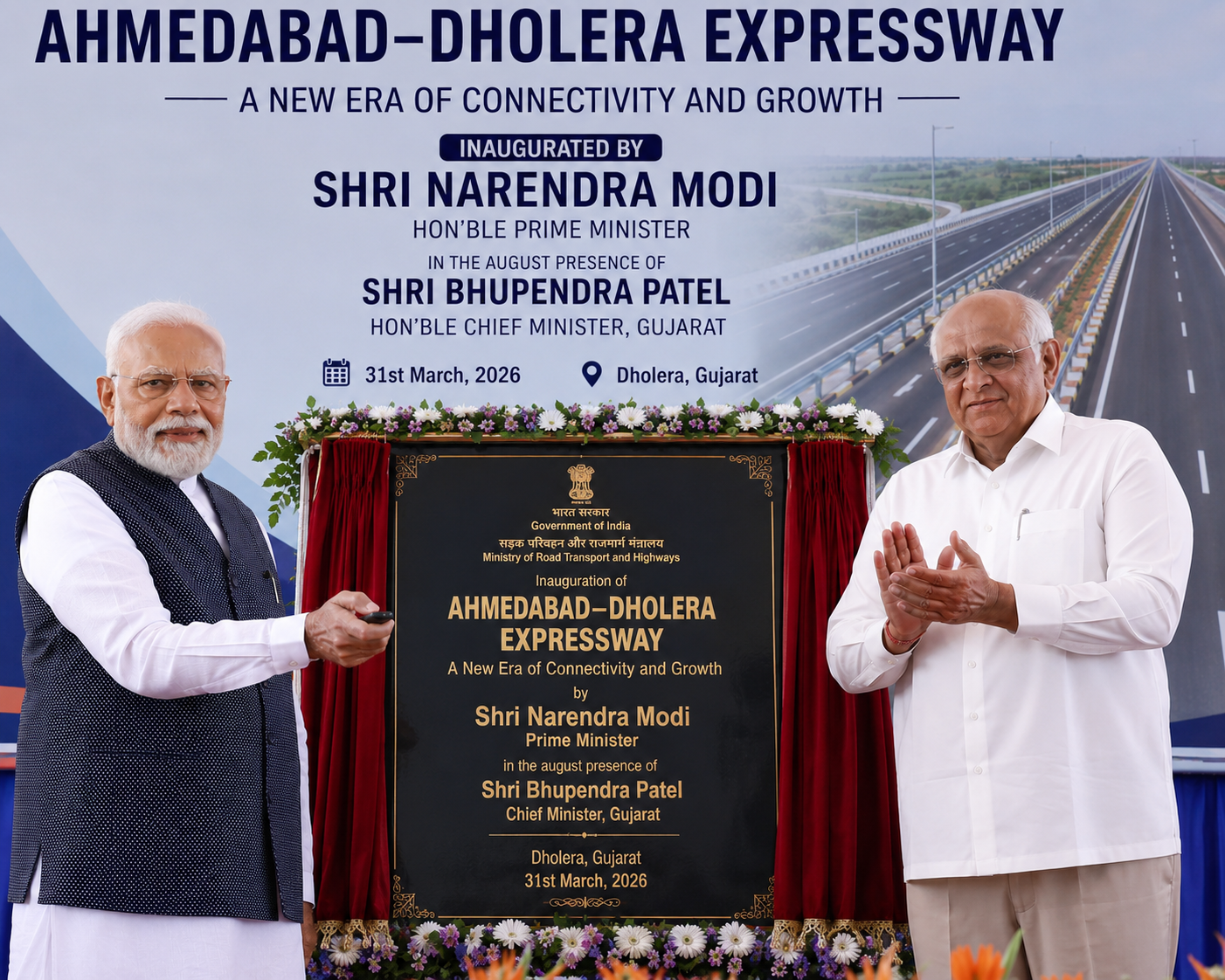
For decades, Dholera sat 109 kilometers south of Ahmedabad, connected by congested state highways and narrow village roads. The drive took two and a half to three hours. That distance kept investors hesitant, industries skeptical, and residents isolated. In March 2026, the Ahmedabad-Dholera Expressway changed that equation entirely.
The inauguration was not just a ribbon-cutting ceremony. It was the moment Dholera stopped being a concept and started being a commute. The 109 km journey now takes 55 minutes. A logistics truck carrying cargo from Ahmedabad can reach Dholera SIR in under an hour. A family can drive to the National Maritime Heritage Complex at Lothal and return the same day without exhaustion.
The expressway is designated as NH-751 (also known as NE-8) and runs from Sarkhej in Ahmedabad to Adhelai near Bhavnagar. It passes through the Dholera SIR Activation Area, connects directly to the airport via a dedicated spur, and links to three major ports: Pipavav, Kandla, and Mundra. It also connects to the Western Dedicated Freight Corridor (DFC), the high-speed cargo railway that is the backbone of the entire DMIC project.
Before the expressway, companies considering Dholera had to factor in a three-hour drive each way. That added cost to logistics, made daily commuting impractical, and created a psychological barrier for investors. The expressway removed all three objections in one stroke.
The expressway was first proposed in 2010 by the Gujarat State Road Department. At that point, Dholera was still in the early planning stages and the road was seen as a future need rather than an immediate priority. In 2019, the National Highways Authority of India (NHAI) took over the project and commissioned SMEC India to prepare the Detailed Project Report (DPR) — the comprehensive engineering document that defines every aspect of the road's design, from alignment to drainage to interchange geometry.
Land acquisition across 24 villages was completed by July 2020, which was unusually fast for an Indian highway project. The speed reflected Gujarat's reputation for efficient land acquisition and the fact that most of the land was agricultural with clear ownership records. Construction contracts were awarded in November 2020, and major civil works began in late 2021. By late 2025, the project was 98% complete. The final inauguration came on March 31, 2026.
Sixteen years from proposal to inauguration is a long time by private sector standards, but for a 109 km access-controlled expressway in India — where highway projects routinely take 10–15 years — this timeline was efficient. The key factor was Gujarat's track record of executing infrastructure projects on schedule, which gave contractors and lenders confidence to commit resources early.
The expressway was divided into four construction packages, each awarded to a different contractor. This approach speeds up construction by allowing multiple teams to work simultaneously on different sections:
| Package | Section | Length | Contractor |
|---|---|---|---|
| 1 | SP Ring Road (Sarkhej) to Sindhrej | 22.0 km | Sadbhav Engineering |
| 2 | Sindhrej to Vejalka (Vataman) | 26.5 km | Sadbhav Engineering |
| 3 | Vejalka to Dholera SIR | 22.5 km | GHV India Pvt. Ltd. |
| 4 | Dholera SIR to Adhelai (Bhavnagar) | 38.0 km | MKC Infrastructure |
Packages 1 and 2 connect Ahmedabad's urban periphery to the agricultural mid-section. Package 3 enters the Dholera influence zone. Package 4 extends south toward Bhavnagar, opening up the coastal economic belt. Together, they create a continuous 109 km corridor that transforms the entire region's accessibility.
An interchange is where the expressway connects to local roads. Without interchanges, the expressway would pass over the landscape without giving anyone access. The six interchanges along the 109 km length are the access points that make the expressway useful to surrounding communities and to Dholera itself:
The 9.56 km airport spur road branches off from the main expressway near the Pipli interchange and runs directly to the Dholera International Airport. This dedicated link means that cargo and passengers can move between the airport and Ahmedabad without passing through local roads or village traffic. For industries that depend on air freight — semiconductor components, pharmaceutical products, time-sensitive manufacturing inputs — this direct connection is a significant logistics advantage.
The airport itself is under construction and will serve as a secondary airport to Ahmedabad's Sardar Vallabhbhai Patel International Airport. Combined with the expressway, it gives Dholera its own air-rail-road connectivity ecosystem. Companies can ship goods by air, truck them to Ahmedabad in 55 minutes, or load them onto the Dedicated Freight Corridor for delivery to Delhi or Mumbai.
The expressway carries a sustainability story that most people do not expect from a highway project. Construction used 20 to 35 lakh tonnes of recycled waste from Ahmedabad's Pirana landfill and over 1.7 crore tonnes of industrial fly ash. These materials were used in earthwork and embankment construction, replacing virgin soil and stone that would otherwise have been quarried from hillsides.
Nearly 97,195 trees were planted across 97 hectares along the route. That is roughly one tree per meter of expressway, creating a green corridor that will mature over the coming decades. The tree cover serves multiple purposes: it absorbs carbon emissions from vehicles, reduces noise pollution for nearby villages, prevents soil erosion along the embankments, and creates a visual buffer that makes the expressway feel less like a scar on the landscape.
It is one of the first major Indian expressways built with significant recycled materials. This is not just good environmental practice — it is a model for how India's future highway network can reduce construction waste while building better roads.
The expressway did not just improve travel times. It changed how people think about Dholera. Before, the 109 km distance felt like a barrier. Now, it feels like a commute. Companies that had been watching Dholera from a distance began moving forward with site visits, plot allocations, and investment decisions. The road removed the most basic objection: "It is too far."
For families considering residential investment, the expressway meant their children could work in Ahmedabad while living in Dholera. A 55-minute commute is shorter than many intra-city commutes in Indian metros. For tourists, Lothal became a day trip instead of an overnight commitment. For industries, logistics costs dropped dramatically because trucks no longer needed to spend three hours on congested village roads.
The expressway also created a real estate effect along its entire length. Land values in villages near interchanges — Sindhrej, Khanpur, Vejalaka — began rising within months of the inauguration. Even if you do not invest inside Dholera SIR itself, the expressway corridor is becoming a valuable economic zone.
The expressway is powerful on its own. But its real significance is how it connects to the other pieces of Dholera's infrastructure puzzle. The Ahmedabad-Dholera Expressway links to the Western Dedicated Freight Corridor, the high-speed cargo railway that connects Delhi to Mumbai. It links to the Dholera International Airport. It links to three major seaports. And it passes directly through the Dholera SIR Activation Area, where the Tata Semiconductor plant, the Solar Park, and the first residential and commercial zones are being built.
No other greenfield city in India has this combination of air, rail, road, and sea connectivity built or under construction simultaneously. The expressway is the piece that makes all the other pieces accessible.
Want the full technical breakdown? Interchanges, engineering details, sustainability features, and investment implications.
Read the Full Expressway Overview →The expressway connects to Dholera International Airport via a dedicated 9.56 km spur road.
Read about the Airport →